RUSSIA - Travel to a Different World
Planning
It all started about a month before the Eid holidays. We knew that the holidays from 26th to 29th May, combined with the weekend, would give us almost a full week to explore a new destination. As always, the family travel committee consisted of three members – myself, Bijili, and Deepali. Our first choice had been South Korea. Unfortunately, obtaining a visa appointment proved difficult, and using our valid US visa would have required a visit to the United States first, which was not practical for an eight-day vacation. While discussing alternatives one evening, I casually suggested, "What about Russia?" To my surprise, both Bijili and Deepali immediately agreed. Within minutes, our next adventure had been decided.
The first pleasant surprise came during the visa process. Despite all the stories we had heard about travelling to Russia during a period of international sanctions, obtaining the visa was remarkably straightforward. All three of us applied for Russian e-Visas, and within four days they were approved and issued electronically.However, the real challenge was only beginning.
Unlike most countries we had visited before, Russia required much more preparation than simply booking flights and hotels. International sanctions meant that Visa and Mastercard cards issued outside Russia would not work inside the country. Booking platforms that travellers normally depend upon had either limited support or did not list many Russian properties at all. We quickly realized that this trip would require a completely different approach. Another requirement that surprised us was travel insurance. Our regular Schengen and worldwide travel insurance policies did not provide coverage for Russia. Due to international restrictions, many insurers either excluded Russia entirely or offered very limited coverage. After considerable research, we found one of the few available options and purchased a dedicated Russian travel insurance policy through AlfaStrakhovanie. The policy provided medical coverage of up to EUR 50,000 and was one of the mandatory requirements for obtaining the Russian e-Visa. It was our first indication that travelling to Russia would be very different from travelling anywhere else. Even something as routine as travel insurance required special arrangements. One website became our guide through this unfamiliar territory: https://russiable.com The information available there proved invaluable and helped us understand how modern-day Russia functions under sanctions.
The first task was solving the payment problem. I opened a YooMoney account, which was surprisingly easy. Funding the account, however, was another story altogether. Since normal international card transfers were not possible, I had to venture into the world of cryptocurrency. After opening a cryptocurrency account and purchasing digital currency, I successfully transferred the equivalent of approximately AED 500, giving me nearly 10,000 Russian Rubles in my YooMoney account. For the first time in my life, I found myself using cryptocurrency not for investment, but simply to buy a metro ticket and a cup of coffee in another country. Once the funds appeared, YooMoney issued me a virtual MIR card. MIR is Russia's domestic payment system, similar in concept to Visa or Mastercard. By linking the card to my phone, I could make contactless payments simply by tapping my mobile device. As a backup, I also opened an account with T-Bank, one of Russia's leading digital banks. The process was surprisingly modern. The bank informed me that a representative would visit my hotel in Moscow to complete identity verification and issue a physical bank card. The idea of opening a bank account in a foreign country before even boarding the flight felt both strange and fascinating. Flights were comparatively easy. Emirates was operating services to Moscow, and booking tickets was straightforward. Interestingly, when we initially booked our flights, Emirates operated four daily services to Moscow. Due to developments in the Middle East, the schedule was later reduced to three flights. Fortunately, Emirates rebooked our flight without any additional charges.
Hotels presented another challenge. Traditional booking platforms such as Booking.com and Hotels.com offered very limited options because of international restrictions. After considerable research, we discovered ZenHotels, a Russian booking platform. Through ZenHotels we successfully reserved and prepaid all our accommodations in Moscow and St. Petersburg. With flights and hotels secured, the next step was transportation. Bijili and I spent several evenings planning our itinerary. We wanted to experience both Moscow and St. Petersburg, and the obvious choice was to travel between the two cities on the famous Sapsan high-speed train. Booking the train, however, was easier said than done. Direct booking was not possible because we did not yet possess Russian banking cards. Eventually, after considerable searching, we found a Russian-Uzbek booking platform that accepted our payment method and successfully secured our Sapsan tickets.
A few days before departure, another important test came. We booked tickets for the Luzhniki Stadium tour in Moscow using our YooMoney account and MIR card. When the booking confirmation arrived successfully, it was a huge relief. For the first time, we knew that our carefully prepared payment systems were actually working. Technology became our lifeline for the entire trip. ChatGPT, Gemini, travel forums, and the Russiable website helped us plan every detail. We downloaded an entire ecosystem of Russian applications before departure. Some apps were not available through the Google Play Store and required installation through RuStore, Russia's own app marketplace. Others had to be installed manually using APK files.
It felt as though we were preparing to visit a parallel digital universe. By departure day, our phones were loaded with:
• Yandex Maps • Yandex Metro • Yandex Go
• Yandex Translate • Moscow Metro App • ZenHotels• MIR Pay • YooMoney • T-Bank
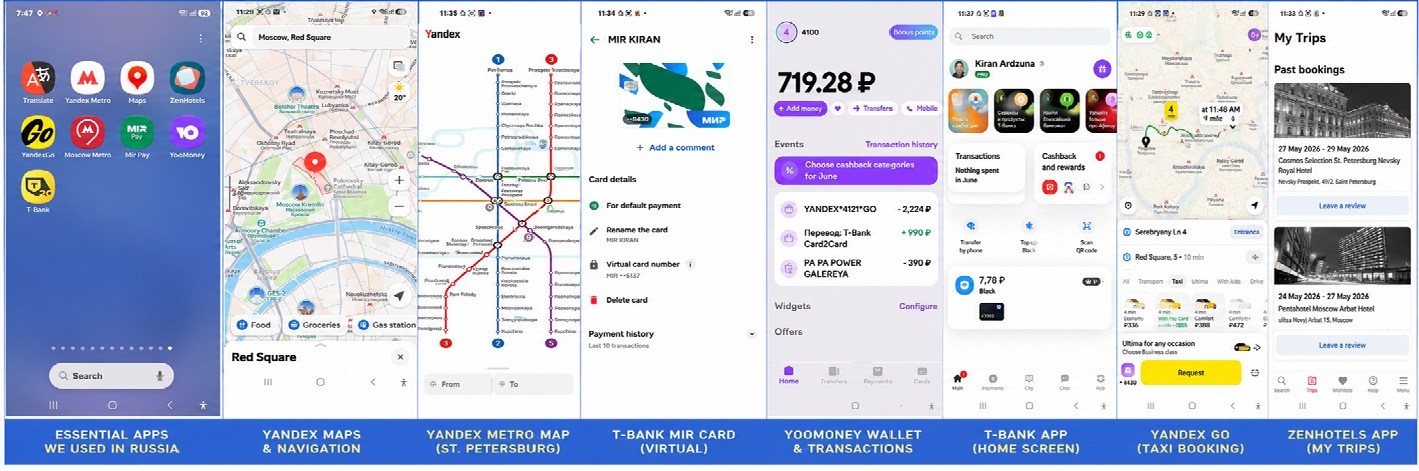
Each application would later prove essential. It was fascinating to discover how Russia had developed its own digital ecosystem in response to international sanctions and restrictions. Many of the services we normally rely on were unavailable, but local alternatives had evolved to fill almost every gap.
Finally, there was one last piece of advice repeated on
almost every Russia travel forum: carry crisp, unfolded US dollar notes,
preferably issued after 2018. Russian exchange counters were known to reject
older or damaged notes. Following this advice, we carefully selected fresh USD
100 bills and also carried a small amount of Russian Rubles purchased in Dubai
for immediate expenses upon arrival.
After weeks of planning, researching, downloading apps,
opening bank accounts, experimenting with cryptocurrency, and solving one
challenge after another, we were finally ready.
For the first time in our travels, we felt less like
tourists and more like explorers preparing to enter a country operating in its
own unique ecosystem.
Russia awaited.
Day 1: Welcome to Moscow - Sat, 23 May 2026 - Dubai ➝ Moscow
The alarm rang early. Although our Emirates flight EK133 was scheduled to depart Dubai at 8:10 AM, our journey had actually begun the previous night. Being seasoned travellers, we had packed everything in advance and carefully organized our documents, currency, banking apps, and travel essentials before going to bed. The plan was simple. Wake up, freshen up, and head to the airport. At around 5:00 AM, I received a notification from Bolt informing me that my airport taxi was on the way. A few moments later, another message arrived. The booking had been cancelled due to driver unavailability. Not exactly the start we had planned. Thankfully, Deepali reacted immediately and booked a Careem taxi. Within minutes, the driver arrived and we were on our way to Dubai International Airport. While travelling to the airport, I contacted Bolt customer support and eventually managed to obtain an AED 50 voucher for the inconvenience. A small victory before the trip had even begun. Dubai Airport was surprisingly calm for a Saturday morning. Check-in, immigration and security formalities were completed quickly, leaving us enough time to enjoy breakfast at the Ahlan Lounge using our Dragon Pass membership. As we walked towards the Ahlan Lounge, an unexpected surprise made the morning even more memorable. Suddenly, I heard someone calling out, "Kiran... Kiran..." I turned around and, to my surprise, it was Dr. Suresh, our old Europe tour companion. We hadn't planned this meeting at all—it was simply one of those wonderful travel coincidences. Dr. Suresh is a frequent traveller and was on his way to Peru. Before our Antarctica expedition, he had been there himself and had generously guided us with valuable contacts, practical tips and first-hand advice, which proved immensely helpful during our planning. We spent a few minutes catching up, talking about our respective travel plans and wishing each other safe journeys. After taking a quick photograph together, we said our goodbyes and continued towards the lounge.
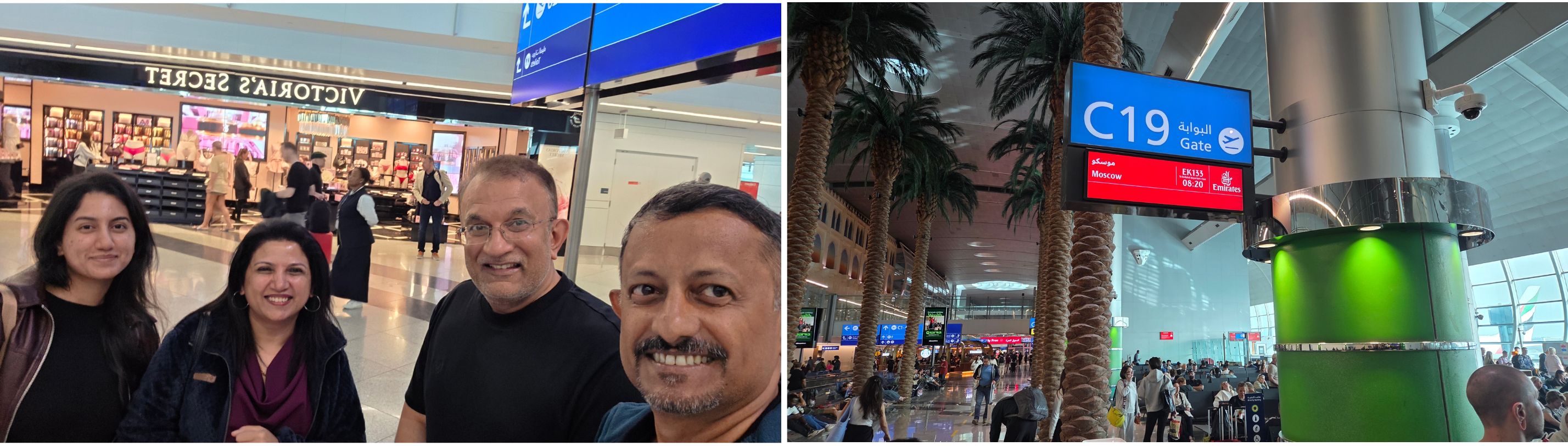
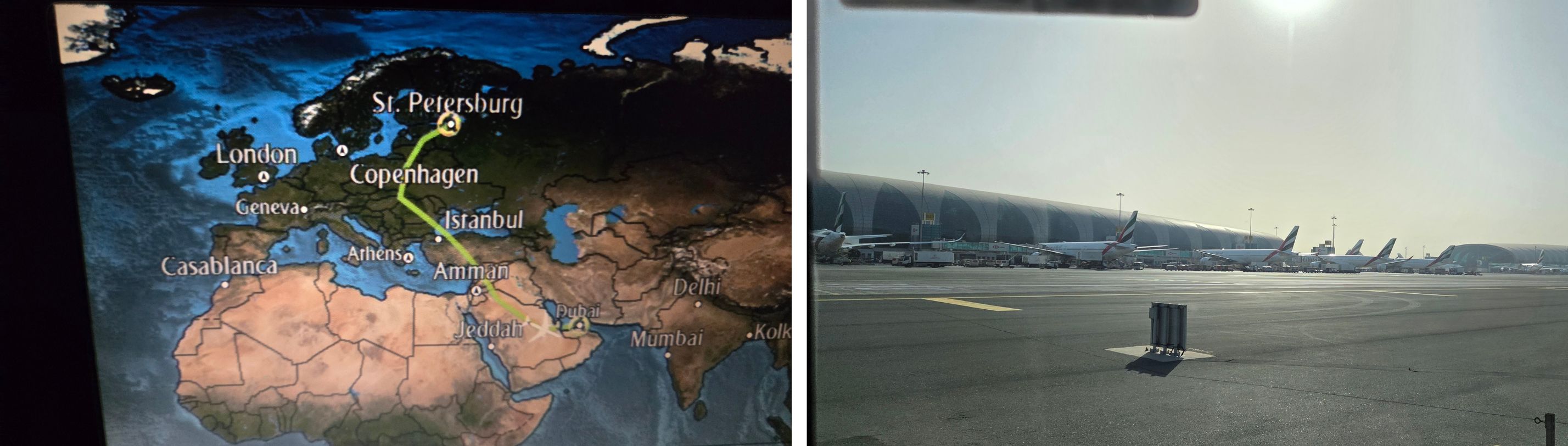
It was a lovely reminder that the travel community is surprisingly small—you never know when you'll bump into a familiar face at an airport, thousands of kilometres away from home.Soon it was time to board Emirates Flight EK133 to Moscow. The aircraft eventually pushed back and departed around 8:50 AM due to congestion and departure delays. Once airborne, I noticed something unusual. The aircraft was not taking the direct route to Moscow. Instead of crossing Iran and Ukraine, the flight followed a long northern arc through Pakistan, Afghanistan, Turkmenistan, Uzbekistan and Kazakhstan before entering Russian airspace. It was a reminder that even aviation routes had been reshaped by current geopolitical realities. The seven-hour flight was comfortable. One of the middle seats in our row remained vacant, giving us some extra space. Interestingly, the passenger originally assigned to that seat had been moved elsewhere because his entertainment screen was not functioning. I enjoyed a small Hennessy, had lunch, and managed to get a few hours of sleep before our arrival.
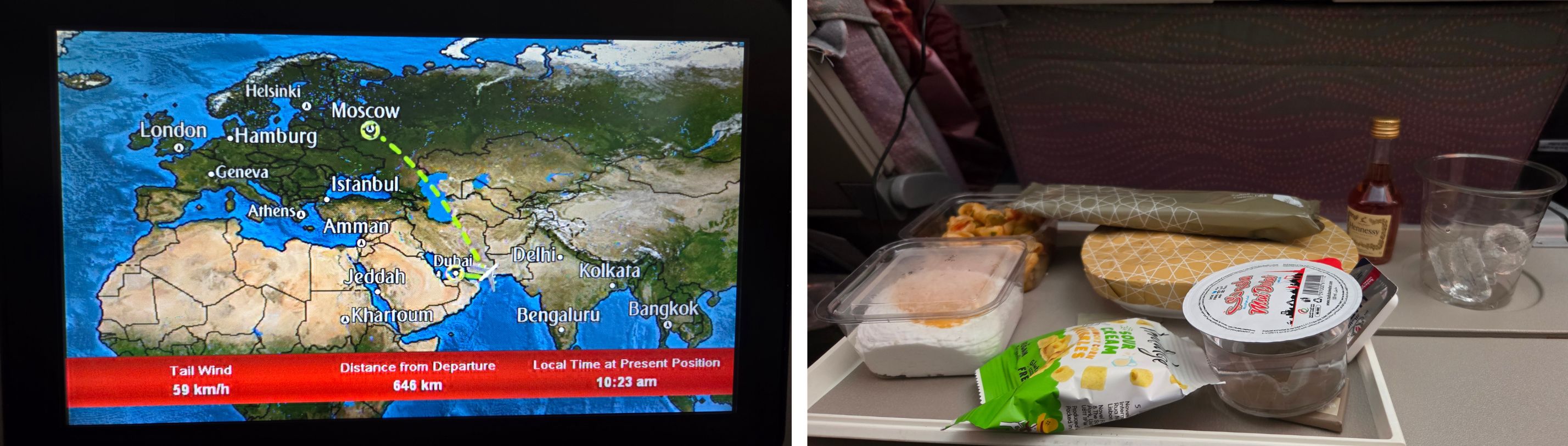
At approximately 2:55 PM local time, we finally touched down at Moscow's Domodedovo Airport. Welcome to Russia. To be honest, I had expected a lengthy immigration process. After all, we were entering a country that had been dominating international headlines for several years. To my surprise, immigration was probably one of the easiest we had ever experienced. The officer checked our passports and e-Visas, printed a small arrival slip, and waved us through. No questions. No interviews. No explanations. Within ten to fifteen minutes, we had officially entered Russia. Our baggage arrived quickly, although we later discovered that one of our suitcases had been damaged during handling. At the time, however, we were simply excited to begin the adventure. The airport itself felt relatively small and quiet compared to the constant energy and scale of Dubai International Airport. As we walked through the arrivals hall, we noticed several familiar faces from our Emirates flight. Throughout the week we would repeatedly encounter many of these same UAE-based travellers at various attractions across Moscow and St. Petersburg. Our next mission was reaching the city. Following the route I had carefully researched before departure, we made our way to the Aeroexpress station located within the airport complex. This would become the first real test of all the preparations we had made before leaving Dubai. Standing at the ticket machine, I unlocked my phone, activated my virtual MIR card through YooMoney, and tapped to purchase three Aeroexpress tickets to Paveletsky Railway Station. Payment successful. That simple transaction brought an enormous sense of relief. For weeks I had been wondering whether our Russian banking arrangements would actually work in real life. Within a few seconds, the answer was clear. They worked perfectly. The Aeroexpress train journey took approximately 45 minutes. The train was surprisingly empty and comfortable. Looking back, taking the train turned out to be the right decision. Another family from our flight chose a taxi and reached the city only about fifteen minutes earlier despite paying significantly more. Upon arriving at Paveletsky Railway Station, we followed the exit route I had studied extensively before departure and booked our very first Yandex taxi. My YooMoney account was already linked as the payment method. Another successful test. The ride to Pentahotel Moscow Arbat took around fifteen minutes and was remarkably inexpensive compared to Dubai taxi fares. Communication with the driver was limited to smiles, hand gestures and a few translated words, but everything worked smoothly. There was a brief moment of confusion when the taxi stopped behind the hotel rather than at the main entrance. We initially thought the driver had made a mistake. Later we discovered that vehicles access the property from the rear, while the main entrance opens directly onto a busy pedestrian area. The driver had actually delivered us to exactly the right place. We arrived at Pentahotel around 5:45 PM.
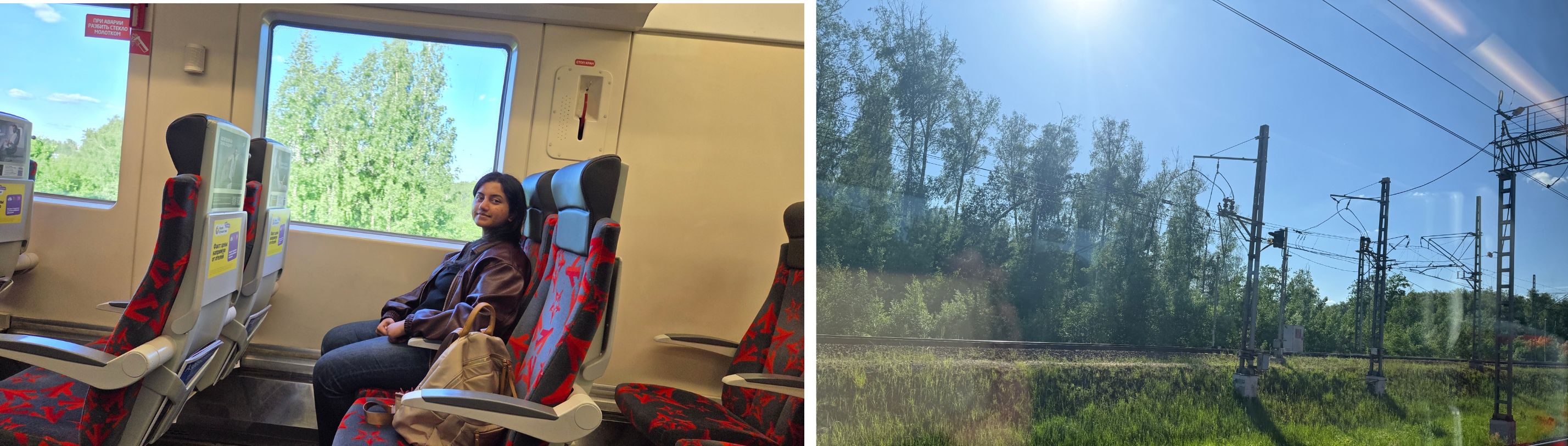
While completing the check-in process, another important appointment awaited us. A representative from T-Bank arrived at the hotel as scheduled. Within a short time, all identity verification procedures were completed and my physical T-Bank card was activated. Another major hurdle cleared. Our room exceeded expectations. The room itself was comfortable and modern, but the real highlight was the view. From our window we could see the brightly lit New Arbat Avenue stretching into the distance, lined with traffic, illuminated buildings and evening activity. The scene immediately challenged many of the stereotypes I had unconsciously carried with me before arriving in Russia. After a short rest, we headed out for our next mission. Cash. We located an exchange counter near Arbat Street and exchanged approximately USD 300 into Russian Rubles at a very reasonable rate. To test the system, I deposited 5,000 Rubles into my newly activated T-Bank account. Seconds later, the notification appeared on my phone. Success. Next came another test. I transferred 500 Rubles internally from T-Bank to YooMoney. Success again. By this stage our financial ecosystem was fully operational.
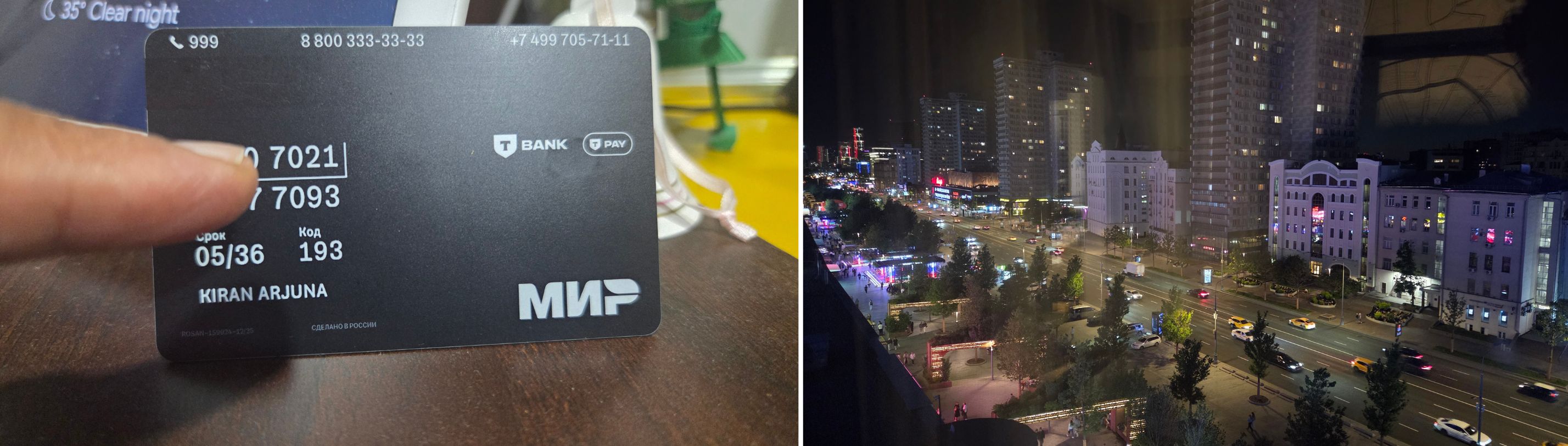
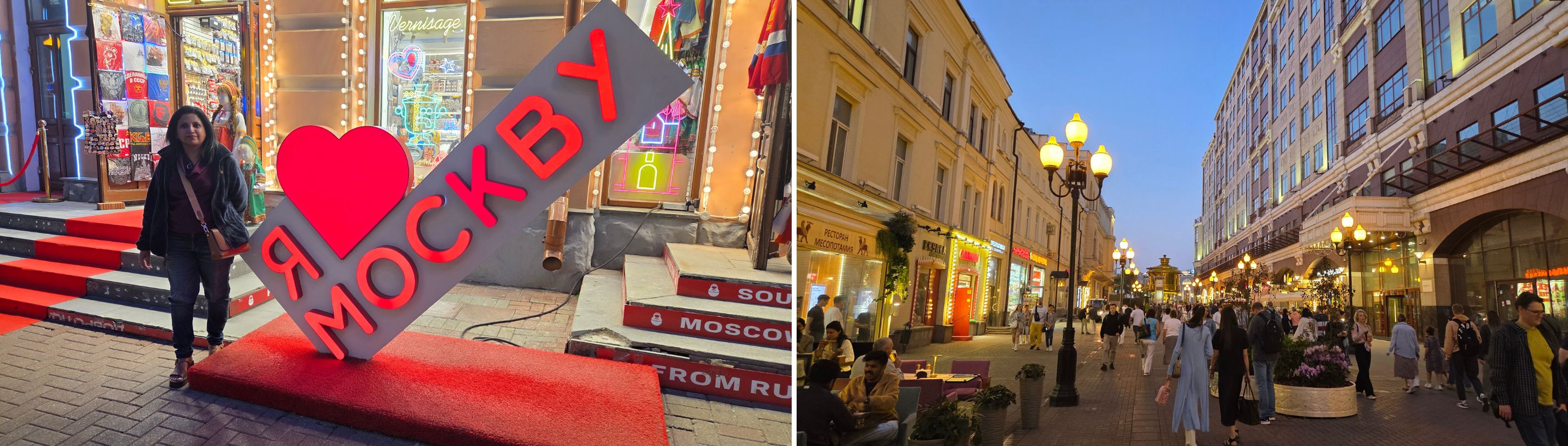
Feeling increasingly confident, we visited a nearby bakery and purchased a few snacks. Deepali used the T-Bank card for the payment and it worked flawlessly. Another small transaction, but another significant milestone for us. We returned to the ATM and deposited an additional 10,000 Rubles. Mission accomplished. The rest of the evening was dedicated to simply absorbing Moscow. Both New Arbat and Old Arbat were buzzing with life. Street performers entertained crowds, restaurants overflowed with customers, and people filled the sidewalks despite the cool weather. The atmosphere was energetic, modern and surprisingly vibrant. For dinner, we chose Varenichnaya, a traditional Russian restaurant. It proved to be the perfect introduction to Russian cuisine. We enjoyed delicious dumplings, pork cutlets, and I celebrated our successful first day with a shot of cognac. As the evening progressed, exhaustion finally began to catch up with us. We returned to the hotel around 11 PM, satisfied that every major challenge we had worried about before departure had been successfully overcome.
- The trip was officially underway. As I looked out over the lights of Arbat Avenue before going to sleep, one thought kept returning to my mind: "I had expected a gloomy Soviet atmosphere, but instead I found a vibrant, modern and energetic city." Moscow had already begun to surprise us.
Day 2 - Moscow Reveals Itself **24th May 2026 - Sunday**
After an eventful first day in Moscow, we finally enjoyed a
relaxed morning. We woke up around 8 AM and headed down for breakfast at
Pentahotel. The breakfast spread was excellent, offering a good mix of
continental and local options. More importantly, we no longer had any concerns
about payments, transportation, or banking. The MIR card worked, T-Bank worked,
YooMoney worked, and Yandex worked. We could finally focus on what we had come
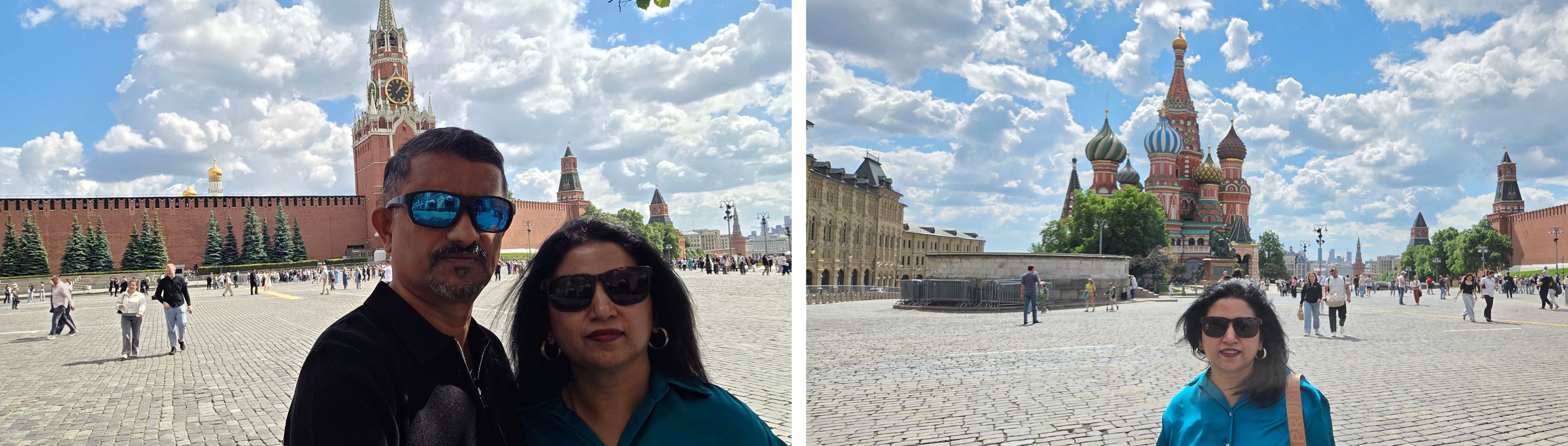
to Russia for – exploring Moscow. Our first destination was the place that every visitor
dreams of seeing. **Red Square.** We booked a Yandex taxi from the hotel and headed towards
the historic heart of Moscow. As we approached the area, the atmosphere began
to change. Modern Moscow slowly gave way to centuries of Russian history. Red
Square is not just a tourist attraction; it is the symbolic center of Russia.
For generations it has witnessed coronations, military parades, revolutions,
political speeches, celebrations, and some of the most significant events in
Russian history. Standing there for the first time was a special moment. On one side stood the red walls and towers of the Kremlin.
On another stood the colorful domes of St. Basil's Cathedral. The vast open
square itself felt larger and more impressive than it appears in photographs. Like every tourist, we immediately began taking photos. Our first major attraction of the day was **St. Basil's
Cathedral**. Built in the 16th century during the reign of Ivan the
Terrible, St. Basil's is perhaps the most recognizable building in all of
Russia. Its colorful onion-shaped domes have become one of the country's most
famous symbols. From the outside it looks almost like something from a fairy
tale. Inside, however, it is completely different. Narrow passageways, small
chapels, painted walls, and centuries-old religious artwork create a unique
atmosphere unlike any church we had previously visited. The entrance fee was not cheap by Russian standards—2,000
Rubles per person—but it was absolutely worth it. This was one of those places
where you leave feeling that you have genuinely experienced a piece of history.
After St. Basil's, we made our way to another iconic
landmark located right in Red Square. **Lenin's Mausoleum.** The preserved body of Vladimir Lenin, the founder of the
Soviet Union, has been displayed here since his death in 1924. Nearly a century
later, visitors from around the world continue to queue for a brief glimpse of
one of the most influential political figures of the twentieth century. After standing in a short queue, we entered the mausoleum.
The atmosphere inside was quiet and solemn. Visitors are not allowed to stop,
talk, or take photographs. Security personnel ensure that everyone keeps
moving. Seeing Lenin's embalmed body preserved after more than one hundred
years was certainly a unique experience and one that few places in the world
can offer. By the time we emerged from the mausoleum, dark clouds had
gathered over Moscow. Without warning, a sudden downpour began. Like many others in Red Square, we quickly ran for shelter
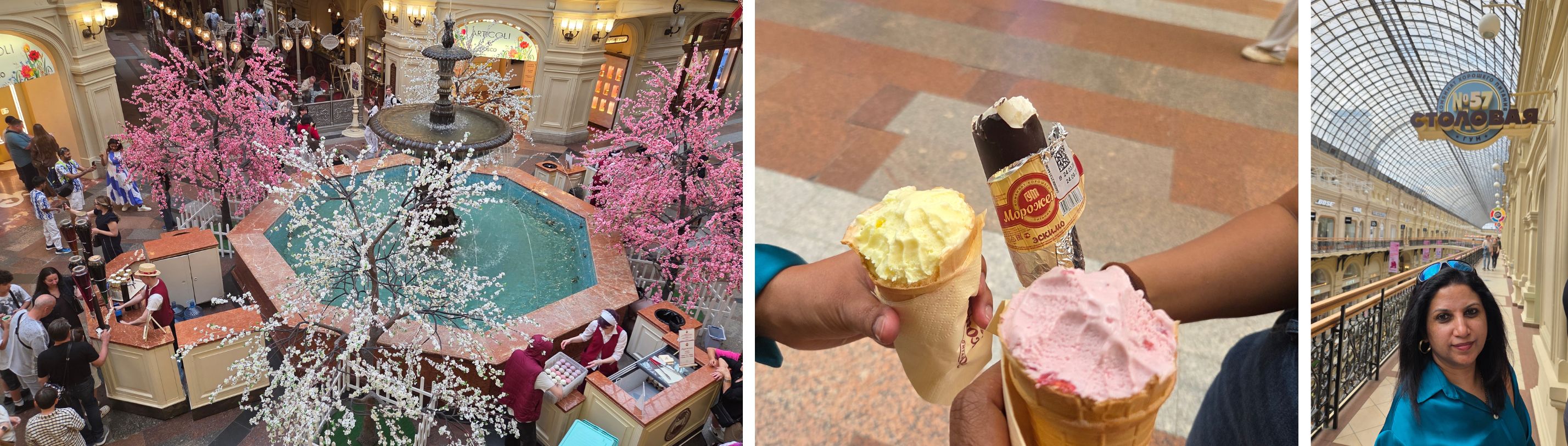
and found ourselves entering the famous **GUM Department Store**. Originally
built in the late nineteenth century, GUM is one of Moscow's most elegant
shopping arcades. Its beautiful glass roof, grand architecture, and historic
atmosphere make it an attraction in its own right. No visit to GUM would be complete without trying its famous
ice cream, so naturally that became our first priority. Lunch followed at **Stolovaya 57**, a popular Soviet-style
self-service restaurant inside GUM. The concept was simple and practical.
Customers pick up a tray, select whatever dishes they want, and then pay at the
end. The food was tasty, reasonably priced, and gave us another glimpse into
everyday Russian dining culture.
After lunch, we planned to continue sightseeing. However,
Bijili had other ideas. While I was already studying the metro map and looking for
the nearest station, she suggested taking a Yandex taxi back to the hotel for a
short break. In the end, comfort won the argument. We returned to Pentahotel, relaxed for a while, and then
prepared for what would become one of the highlights of our entire Russia trip. **The Moscow Metro.** By late afternoon, we headed to Arbatskaya Metro Station.
With assistance from a friendly metro employee, we purchased three unlimited
travel passes valid for three days at a cost of approximately 800 Rubles each.
Payment was made using our T-Bank card. And then the adventure began. The Moscow Metro is not merely a transportation system. It
is a city beneath the city. At first glance, the network looked overwhelming. Multiple
colors, multiple lines, countless intersections, transfer stations, underground
passageways, and some of the longest escalators we had ever seen. Yet somehow it all worked perfectly. Armed with the Moscow Metro app and Yandex Maps, we began
navigating our way through the system. The trains were frequent, clean, and
remarkably efficient. One challenge remained: once you reached your destination
station, figuring out the correct exit often became another puzzle entirely. Still, solving those little puzzles became part of the fun. Our first metro destination was **Kropotkinskaya Station**, Before our exit of our first journey, another amusing
incident taught us how the Moscow Metro actually worked. At Arbatskaya Station, we simply tapped our Metro cards at
the entrance gates and entered the system. After completing our journey, the
three of us reached the exit gates and immediately began searching for the
place to tap our cards again—just like we do in Dubai. We looked around in confusion. A local lady standing nearby quickly realised what was
happening. Smiling, she simply walked towards the gate, which opened
automatically as she approached. Through simple hand gestures, she indicated
that we could do the same. Only then did we understand. Unlike the Dubai Metro, where passengers tap both while
entering and exiting and the fare is calculated according to distance
travelled, the Moscow Metro operates differently. Since we had purchased
unlimited travel passes valid for three days, there was no need to tap while
leaving. Entry required validation, but exiting was completely automatic. It was a small but memorable lesson—and one more example of
how travelling teaches you something new every single day.
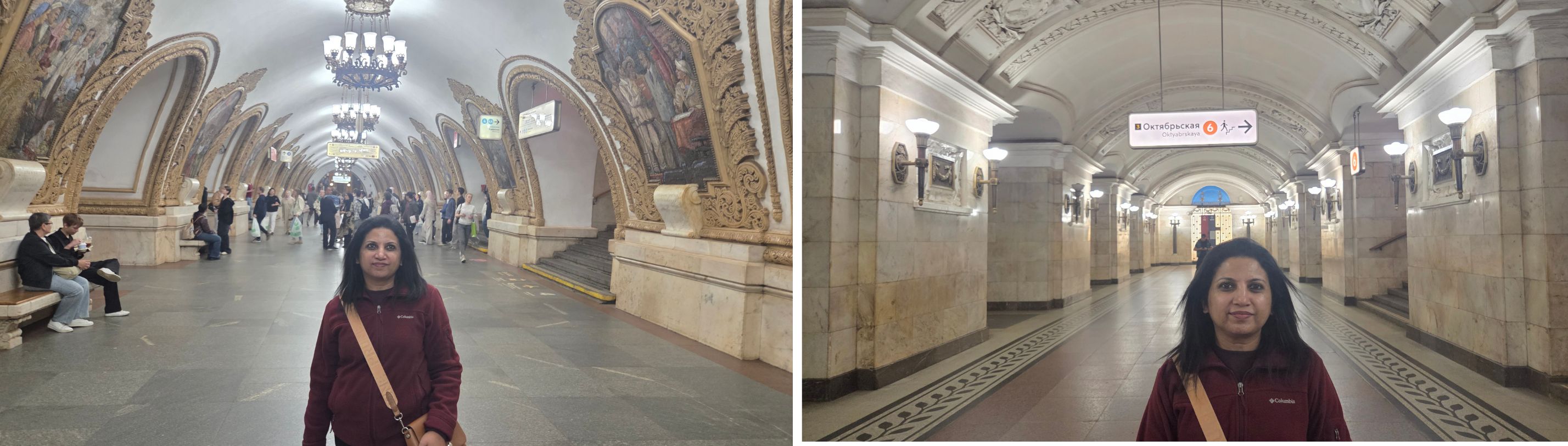
From here we walked to the magnificent **Cathedral of Christ
the Saviour**. This enormous cathedral is the largest Orthodox Christian
church in Russia. The original structure was demolished during the Soviet era
before being rebuilt in the 1990s. Its golden domes dominate the Moscow skyline
and can be seen from considerable distances. Unfortunately, we arrived too late
to enter the cathedral, but even viewing it from the outside was impressive. We
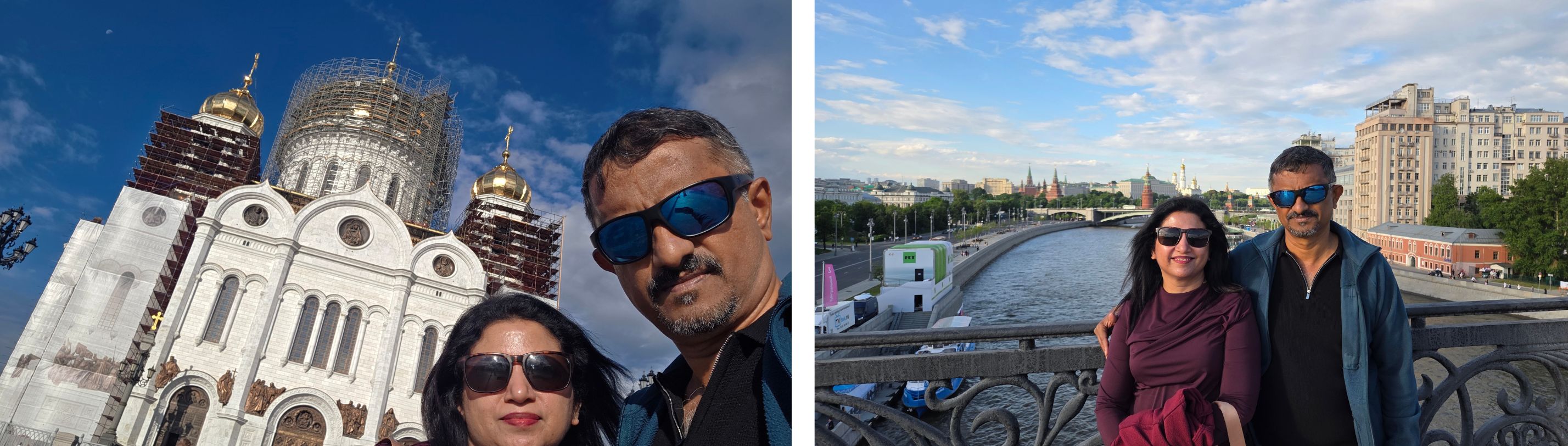
spent some time walking around the area and crossed the nearby bridge, which
offered beautiful views of Moscow and the Moskva River. After spending some time around the Cathedral of Christ the
Saviour and capturing photographs from the nearby bridge overlooking the Moskva
River, we returned to Kropotkinskaya Metro Station. Our next destination was Zaryadye Park. We travelled by Metro to Okhotny Ryad Station and initially
planned to walk the remaining distance. The park was only about fifteen minutes
away on foot.
However, as usual, Bijili had a different plan. Rather than
walking, she insisted on taking a Yandex taxi. Within minutes we had booked a
ride and were conveniently dropped right at the entrance. In hindsight, it was a good decision. Opened in 2017, Zaryadye Park is one of Moscow's newest and
most innovative public spaces. Built on the site of the former Rossiya Hotel,
the park combines modern architecture, landscaped gardens and spectacular
viewpoints while showcasing different climatic zones found across Russia. The
park itself is beautifully designed and provides a refreshing contrast to the
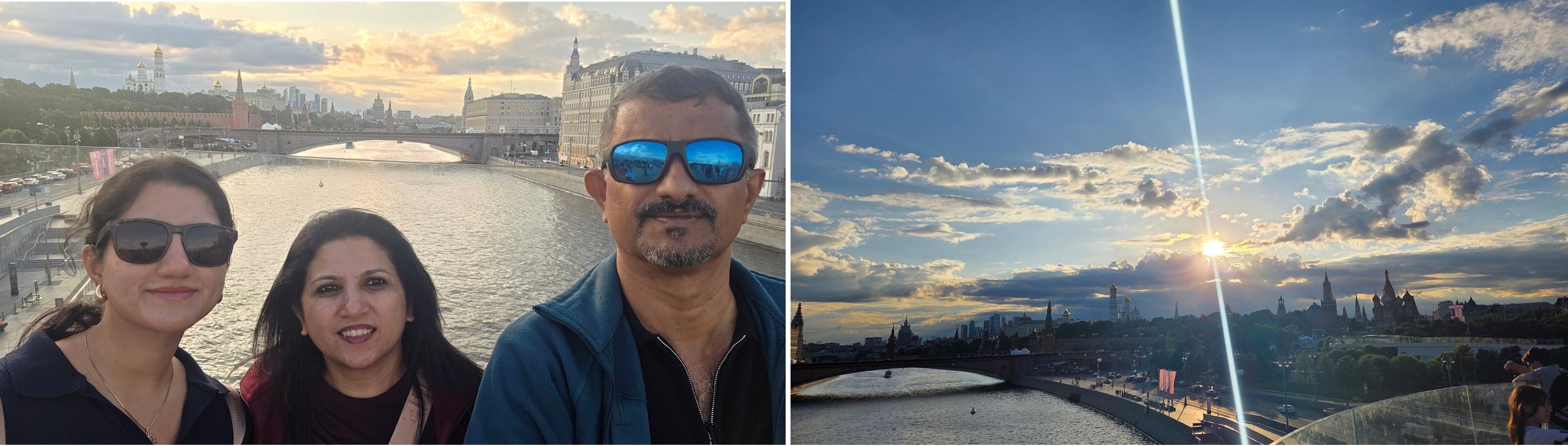
historic monuments surrounding Red Square and the Kremlin. The highlight of our visit was undoubtedly the famous Floating
Bridge. Although called a bridge, it does not actually cross the
river. Instead, it extends dramatically over the embankment in a V-shaped
cantilever design, giving visitors the feeling of floating above the city.
Standing at the end of the bridge, we were rewarded with magnificent panoramic
views of Moscow. From one spot we could see: The
Kremlin walls St.
Basil's Cathedral The
Moskva River Modern
Moscow skyscrapers Historic
city buildings stretching into the distance The weather was perfect, with bright sunlight illuminating
the city skyline. It turned out to be one of the best photography locations of
our entire Moscow stay, and we spent quite some time taking pictures and simply
enjoying the view.
Once we had finished exploring the park, we walked to Kitay-Gorod
Metro Station and continued our Metro adventure towards the magnificent
Kievskaya Station. From there we returned to the Metro and continued to
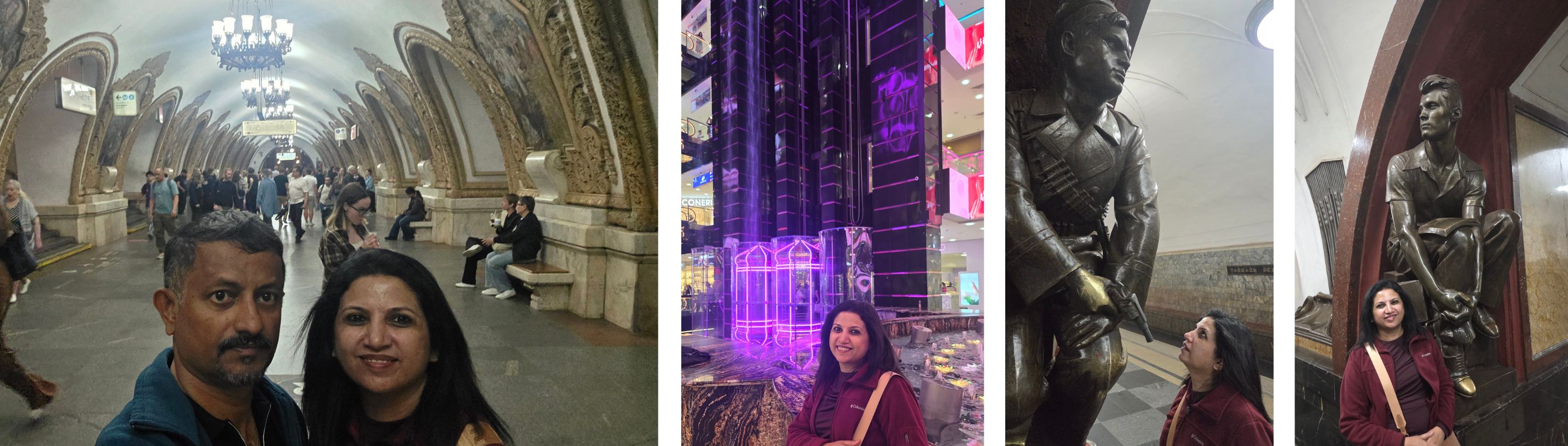
**Kievskaya Station**. If someone asks me which metro station they absolutely must
see in Moscow, Kievskaya would be near the top of the list. The station is famous for its magnificent chandeliers,
marble columns, and decorative mosaics depicting the friendship between Russia
and Ukraine during the Soviet era. More than a metro station, it feels like an
underground palace. Photographs simply do not do justice to the scale and
beauty of the place. It is one of those locations that must be experienced with
your own eyes. After spending considerable time admiring the station, we
emerged above ground and stopped for snacks at a nearby **Teremok** restaurant.
By now, we were becoming increasingly comfortable using Russian payment
systems, metro networks, and navigation apps. What had seemed intimidating before the trip was now
beginning to feel routine. As evening approached, we returned via Metro to Arbatskaya
Station and walked back towards the hotel. For dinner, we kept things simple
and grabbed shawarmas from a nearby Turkish restaurant before calling it a day. Back in the hotel room, all three of us agreed on one thing. The highlight of the day was not just Red Square. It was learning to use and understand the Moscow Metro. The combination of Yandex Maps and the Metro app made
navigating one of the world's largest underground systems surprisingly easy.
What impressed us even more was the mobile connectivity. The apps continued to
work perfectly deep underground, inside tunnels, and throughout the metro
network. As we prepared for bed, tired but satisfied, we reflected on
the day. Red Square had delivered the history. The Moscow Metro had delivered the experience. And Moscow itself continued to exceed our expectations.
Day 3 -May 25, Monday- Kremlin, Football & Sparrow Hills
By now we had settled comfortably into the rhythm of Moscow. We woke up around 7 AM and enjoyed another excellent breakfast at Pentahotel Arbat. One of the advantages of staying in Arbat was the easy access to both the Metro and Yandex taxis, allowing us to switch between the two whenever convenient. Our first destination for the day was perhaps the most important landmark in Russia. **The Moscow Kremlin.**
From Arbatskaya Metro Station, we travelled to Aleksandrovsky Sad Station and made our way towards the Kremlin entrance. The Kremlin is often misunderstood as a single building. In reality, it is a massive fortified complex situated at the heart of Moscow. Surrounded by red brick walls and towers, the Kremlin contains cathedrals, government buildings, museums, palaces and historic monuments. For centuries it served as the residence of Russian Tsars and today remains the official residence of the President of Russia. Entry tickets cost approximately 1,100 Rubles per person.Once inside, it quickly became clear that this was not a place that could be rushed. The Cathedral Square alone contains several magnificent churches with golden domes that dominate the skyline. The architecture, history and sheer scale of the complex made it one of the most impressive attractions of our Moscow visit. We spent nearly three hours exploring the grounds, walking through centuries of Russian history. Everywhere we looked there were reminders of Russia's imperial past, from the beautiful churches to the famous Tsar Cannon and Tsar Bell. As we were leaving the Kremlin, the Moscow weather once again decided to surprise us. Dark clouds gathered overhead and a sudden shower forced us to seek shelter for a while. Fortunately, the rain eased quickly and we continued with our next mission of the day.
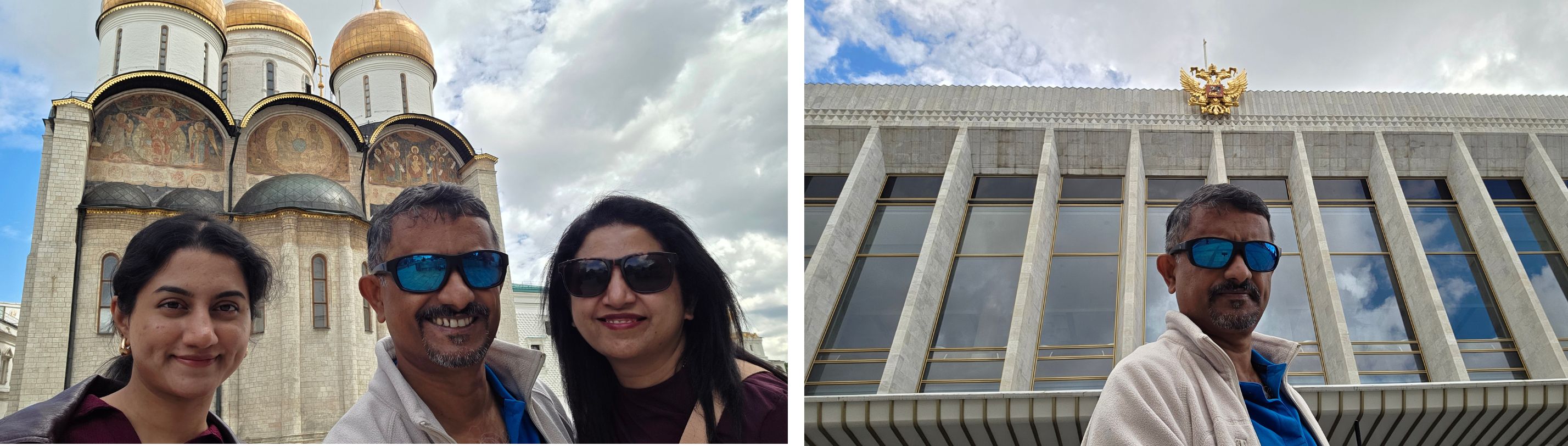
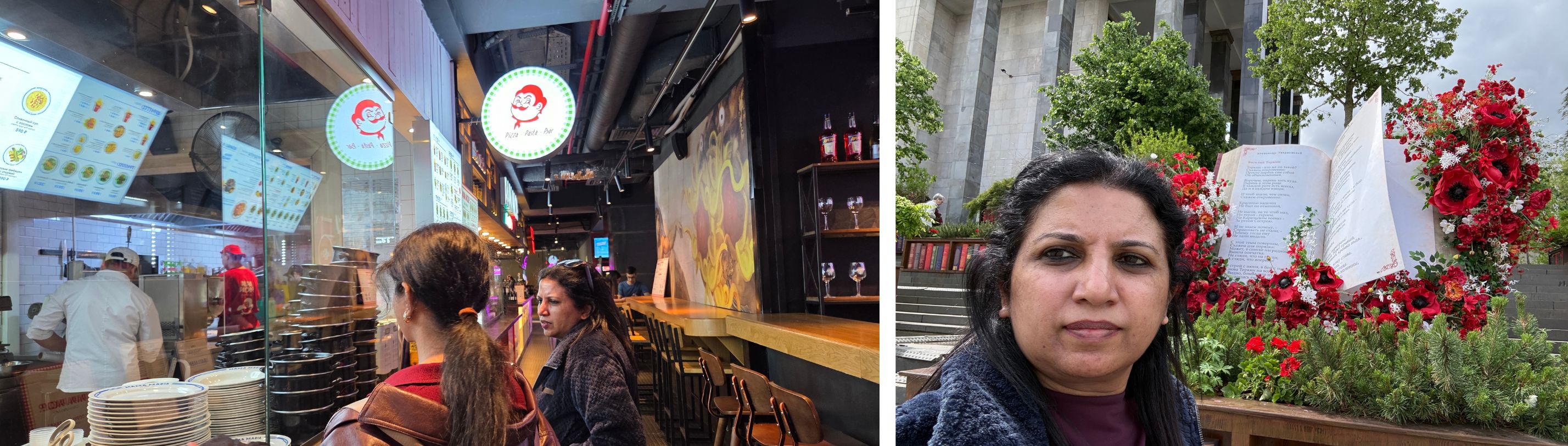
Lunch- As usual, Bijili had already done her research. She had selected **Vokrug Sveta**, a popular food hall featuring a variety of international food counters. After a short Yandex ride, we arrived and immediately understood why she had chosen the place. The atmosphere was lively and modern. We selected grilled pork, chicken and a variety of side dishes. I also enjoyed a cold beer while reflecting on how smoothly everything had been going so far. Good food, good company and a short break from sightseeing. Perfect. After lunch we decided to return to the hotel for a short rest before the highlight of the evening.
Or at least that was the plan. As soon as we exited Arbatskaya Metro Station, we became completely disoriented. Despite staying in the same area for several days, we somehow managed to emerge from the wrong metro exit and found ourselves near Biblioteka Station. The Moscow Metro is extremely efficient, but choosing the wrong exit can easily place you several blocks away from where you intended to be. After wandering around for a while and checking maps repeatedly, we realized we were much farther from the hotel than expected. At that moment we decided to book a Yandex taxi. This led to another interesting lesson about Moscow. Unlike Dubai, where a taxi can often pick you up directly from your doorstep, many locations in Moscow have designated Yandex pickup points. Passengers are often required to walk a short distance to a specific pickup location. While trying to figure out the correct route, a nearby police officer noticed our confusion. Despite the language barrier, he patiently used hand gestures to explain how to use the underground pedestrian passage to cross the road and reach the correct pickup point. It was a small interaction, but one we remembered. The officer was polite, helpful and genuinely interested in assisting us despite not speaking English.
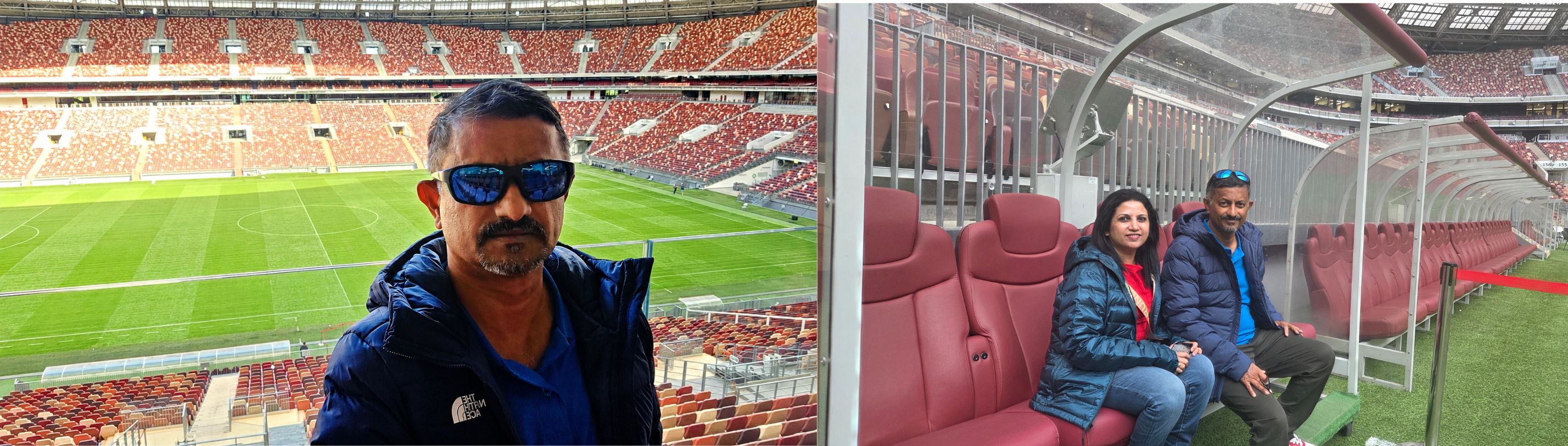
Back at the hotel we freshened up quickly before heading to one of the attractions I had been looking forward to for months.-Luzhniki Stadium.
A Yandex taxi took us to the enormous Luzhniki Sports Complex. Calling it a stadium almost feels inadequate. Luzhniki is a massive sports complex covering a vast area along the Moskva River. It is Russia's most famous stadium and has hosted some of the biggest sporting events in history, including the 1980 Olympic Games, the UEFA Champions League Final and, most famously, the 2018 FIFA World Cup Final between France and Croatia. Like millions of football fans around the world, I had watched that final on television. Never did I imagine that one day I would stand inside the very stadium where it took place. Finding the correct entrance was not easy. The complex is huge, and despite our preparation we initially struggled to locate the assigned gate. Fortunately, we met a gentleman who spoke excellent English. His directions were simple. "Keep walking until you see the Lenin statue. Your entrance is right behind it." And he was right. We arrived just in time for the guided tour. The tour itself was conducted entirely in Russian, but thanks to Yandex Translate and some creative interpretation, we managed surprisingly well. The experience exceeded expectations. We visited:
* The players' dressing rooms
* Team preparation areas
* VIP seating sections
* Press conference rooms
* Technical zones
* The substitutes' benches
* Pitch-side viewing areas
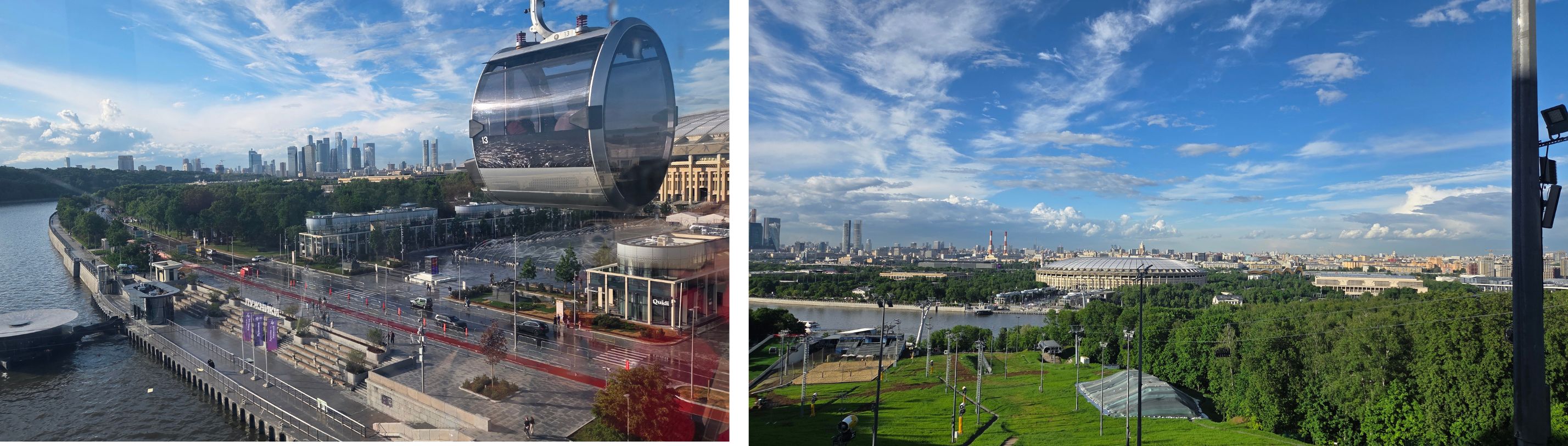
Perhaps the most memorable moment was standing beside the field itself, imagining the atmosphere during the 2018 World Cup Final. The stadium was empty during our visit, yet it still felt impressive. One can only imagine the energy when nearly 80,000 spectators fill the stands. After completing the tour, we noticed another attraction nearby. The **Moscow Cable Car**. Since it was within walking distance, we decided to take a one-way ride towards Sparrow Hills. This turned out to be one of the pleasant surprises of the trip. Unlike many cable cars designed purely for tourism, this one actually functions as part of the city's transportation system, connecting different elevations along the river and providing access to Sparrow Hills.
The ride offered beautiful views of the Moskva River, Luzhniki Stadium, surrounding parks and parts of the Moscow skyline. As the cabins climbed higher, the city unfolded beneath us. The destination was **Sparrow Hills**, one of Moscow's most famous viewpoints. Historically known as Vorobyovy Gory, or Sparrow Hills, the area has been a favorite observation point for centuries. It offers one of the best panoramic views of Moscow and has long been associated with students, artists and visitors seeking a perspective of the city from above. After enjoying the views, we briefly considered taking the Metro back. However, by this stage of the day, Bijili had reached her limit. The combination of the Kremlin, extensive walking, Luzhniki Stadium and the cable car adventure had finally taken its toll. A Yandex taxi won the debate. We returned comfortably to the hotel. What felt strange was that despite the late hour, daylight still filled the streets. Moscow's long spring evenings were becoming increasingly noticeable and gave us more time to explore than we were accustomed to back home. Rather than heading out again, we decided to keep the evening simple. We ordered food at the hotel and relaxed. Deepali still had some energy left and took a short stroll along the lively Arbat Street before returning. As for the rest of us, the day had been more than enough. Three completely different experiences had filled the day. The history of the Kremlin, The sporting legacy of Luzhniki. The panoramic views from Sparrow Hills.
As we switched off the lights and prepared for sleep, there was only one conclusion. Moscow continued to surprise us.
Day 4 - May 26, Tuesday : Discover USSR Space Legacy
After three days of exploring Moscow's historic landmarks, beautiful Metro stations and sporting icons, Day 4 was dedicated to something completely different.
Space - Like every morning, we started the day with a hearty breakfast at Pentahotel before making our way to Arbatskaya Metro Station around 10 AM. Our destination lay on the northern side of Moscow. The Metro journey itself became part of the experience. We had now become reasonably confident navigating Moscow's colourful underground network. What had appeared confusing on our first day had gradually become second nature. The Metro app and Yandex Maps guided us perfectly as we travelled across the city towards VDNKh Station. It was one of the longer Metro journeys of our trip, but certainly one of the most interesting. As soon as we emerged from VDNKh Metro Station, one structure immediately caught our attention. Standing proudly before us was the **Museum of Cosmonautics**, identified by the enormous titanium monument known as the **Monument to the Conquerors of Space**. Rising over 100 metres into the sky like a giant rocket launching into space, it is one of Moscow's most recognisable monuments. The bright sunshine made the entire area look spectacular and we spent several minutes taking photographs before entering the museum.
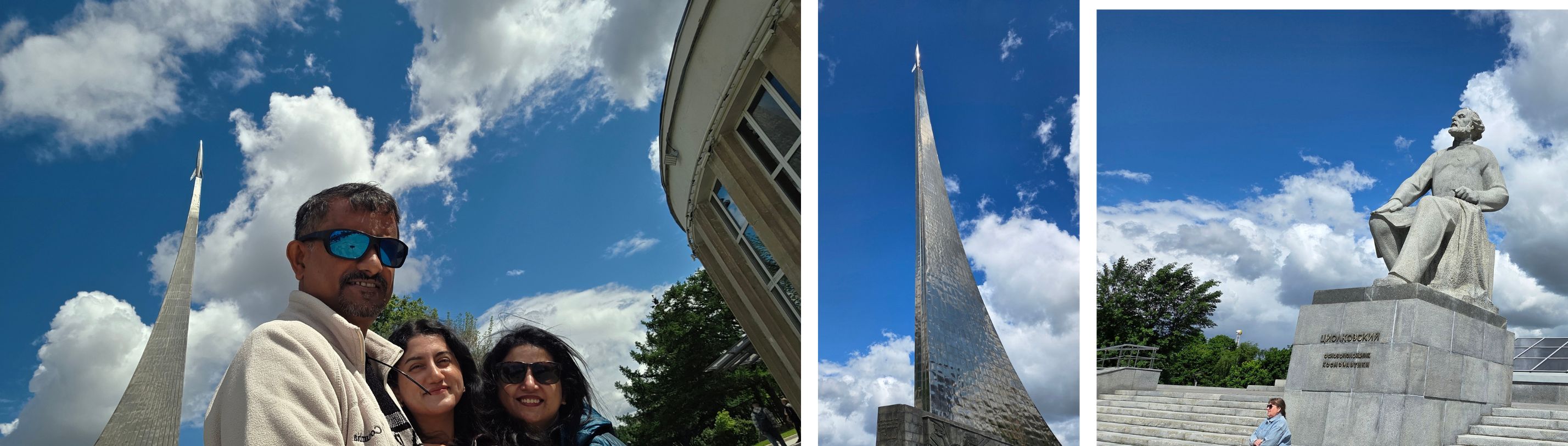
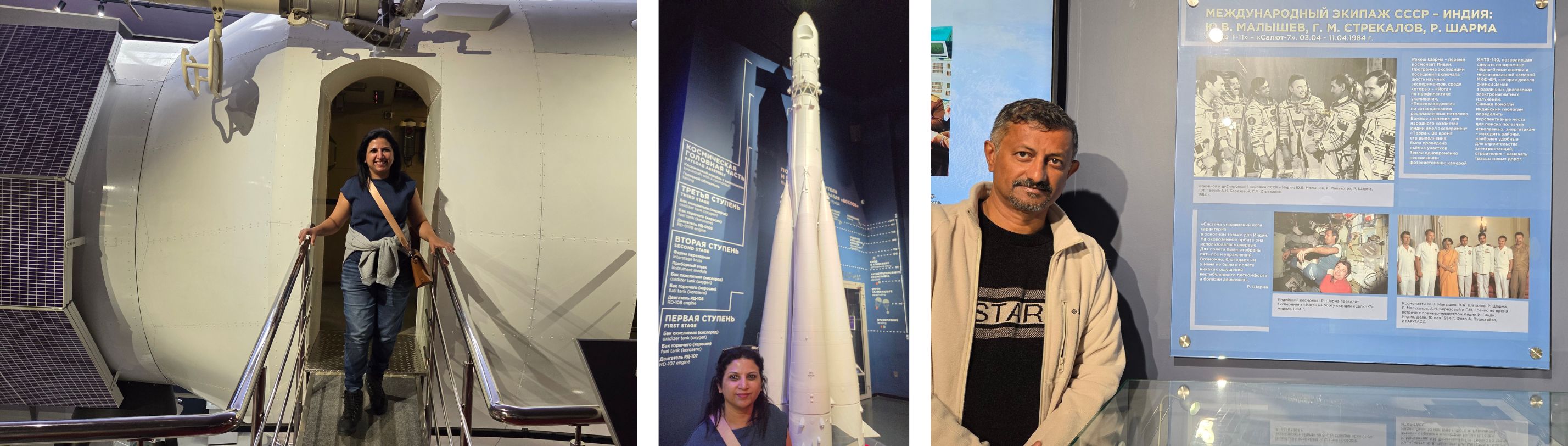
Then began one of the most educational experiences of our entire Russia trip. The Soviet Union was one of the world's greatest space pioneers. During the Space Race of the twentieth century, it achieved several historic firsts that changed human history forever. It launched **Sputnik 1**, the world's first artificial satellite in 1957. In 1961, **Yuri Gagarin** became the first human to travel into space. Soon after came the first woman in space, the first spacewalk and numerous other groundbreaking achievements. Even today, Russia continues to play an important role in global space exploration. While reading about the Soviet and Russian space programmes inside the museum, I was amazed to learn that the Soviet Union and Russia together have launched **more than 5,000 satellites, spacecraft and other objects into space** over the decades. It was difficult to comprehend the scale of their contribution to space science. The museum itself was exceptionally well designed. Original spacecraft, rockets, space suits, satellites, engines, scientific instruments and countless interactive exhibits brought decades of space exploration to life. Every gallery reflected the determination and ambition of the Soviet space programme. For anyone interested in science or engineering, this museum is an absolute must-visit. One exhibit, however, touched me personally. Inside the museum we found photographs of **Rakesh Sharma** alongside **Prime Minister Indira Gandhi**. Instantly I was transported back to my childhood. Like millions of Indians, I still remember watching the famous conversation between Indira Gandhi and Rakesh Sharma after he became the first Indian to travel into space in 1984 aboard the Soviet Soyuz spacecraft.
When she asked him how India looked from space, his reply has remained unforgettable: **"Saare Jahan Se Achha."**
Standing inside a Russian museum, thousands of kilometres from India, seeing those photographs brought back memories that many Indians of my generation still cherish. By the time we left the museum, we had gained a completely different appreciation for Soviet scientific achievements.
From there we walked towards another famous Moscow attraction. **VDNKh.**
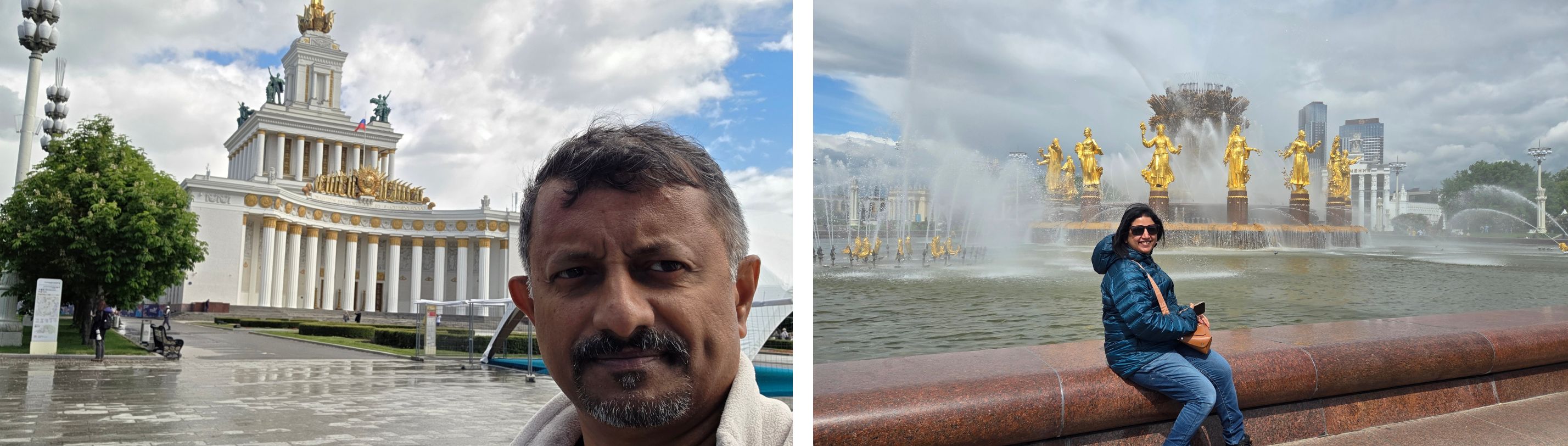
Originally developed during the Soviet era, VDNKh is an enormous exhibition and cultural park celebrating the achievements of the Soviet republics in agriculture, science, industry and technology. The beautifully designed pavilions represent different regions and sectors of the former Soviet Union. The closest comparison I could think of was Dubai's Global Village. However, instead of representing countries from around the world, VDNKh primarily showcased the achievements and cultures of the Soviet republics and neighbouring regions. The scale of the complex was astonishing. After exploring the entrance area, we stopped for a few snacks before continuing towards one of Moscow's most beautiful fountains. The **Friendship of Peoples Fountain**. Surrounded by sixteen magnificent golden statues representing the republics of the former Soviet Union, this iconic fountain symbolises unity and cooperation among the Soviet peoples. The combination of golden sculptures, sparkling water and bright blue skies made it one of the most photogenic locations of our Moscow trip. We spent quite some time here taking photographs. The sunlight was perfect.
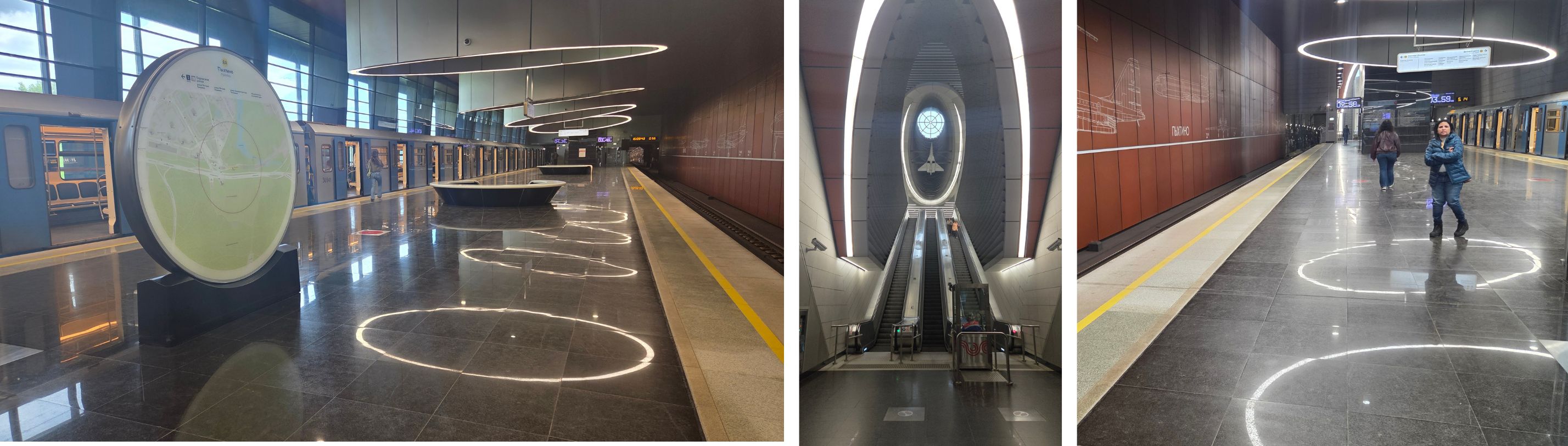
By early afternoon, we returned to the Metro for another architectural adventure.This time our destination was **Elektrozavodskaya Metro Station**. Although reaching the station required another long Metro journey, every minute was worthwhile. Unlike the grand palace-style stations we had previously visited, Elektrozavodskaya has a completely different character. Its distinctive ceiling, illuminated by hundreds of circular lights, creates an atmosphere that feels almost futuristic. Walking through the station almost felt like stepping onto the set of a science fiction movie. Once again, Moscow Metro proved that every station tells its own story. By now we were beginning to understand why so many people consider it one of the world's greatest Metro systems.After several hours of sightseeing, we decided to satisfy another craving. Indian food. Unfortunately, this became our first disappointing meal of the trip. We chose **Tajj Restaurant**, hoping for familiar flavours after several days of Russian cuisine. Although the restaurant itself looked attractive, the food was disappointing. The rice was undercooked and several dishes simply did not meet our expectations. After explaining our concerns as best we could despite the language barrier, we finished our meal and returned to the hotel for a well-deserved rest. Fortunately, the day still had one more magical surprise waiting.
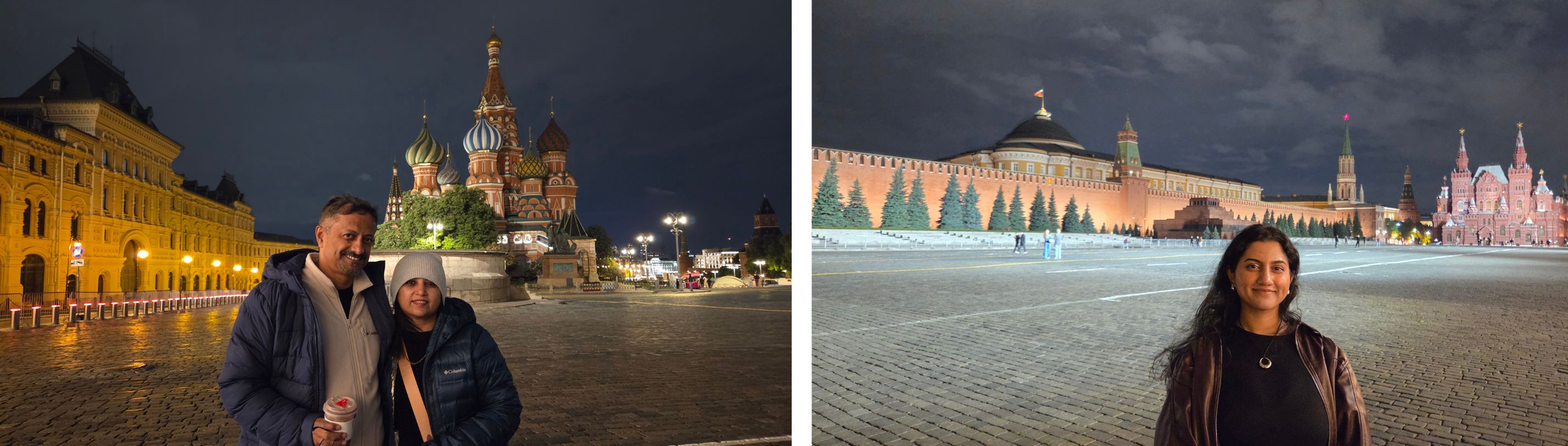
At around 9 PM we booked another Yandex taxi and returned to **Red Square**. If Red Square is beautiful during the day, it becomes truly magical after sunset. The crowds had almost disappeared. The illuminated walls of the Kremlin, the colourful domes of St. Basil's Cathedral and the perfectly lit cobblestone square created an unforgettable atmosphere. It felt peaceful, elegant and almost surreal. Without the daytime crowds, we were finally able to take some of our best photographs of the entire trip. The lighting was simply perfect. Around 10:30 PM we returned to Pentahotel. Rather than venturing out again, we ordered dinner directly from the hotel and reflected on another remarkable day. History had impressed us during the previous days. Today, it was science, engineering and human achievement that left the strongest impression. Before coming to Russia, I knew about Sputnik and Yuri Gagarin. After visiting the Museum of Cosmonautics, I understood just how enormous the Soviet contribution to space exploration had truly been. It was a day that left us inspired.
Day 5 - May 27, Wednesday - Moscow to St.Petersburg
Every journey reaches a point where it is time to say goodbye. After spending four unforgettable days exploring Moscow, we woke up a little earlier than usual. Following another excellent breakfast at Pentahotel Arbat, we packed our luggage, completed the check-out formalities and booked one final Yandex taxi. As the taxi drove through the familiar streets of Arbat, I quietly thanked Moscow. It was unlike any city I had ever visited.
Before travelling to Russia, I had imagined a grey Soviet city with cold buildings and serious faces. Instead, Moscow had welcomed us with magnificent Metro stations, grand architecture, beautiful parks, world-class public transport, friendly people despite the language barrier, and a fascinating blend of history, engineering and modern technology. It had completely changed my perception of Russia.Our destination was **Leningradsky Railway Station**, one of Moscow's oldest and most important railway terminals. Located at Komsomolskaya Square, often called the "Square of Three Stations," Leningradsky Station has connected Moscow with St. Petersburg since the nineteenth century. It is the oldest railway station in Moscow and serves as the starting point for the famous high-speed Sapsan trains. The station itself was elegant, well maintained and surprisingly calm. After verifying our passports, railway staff directed us towards our carriage.
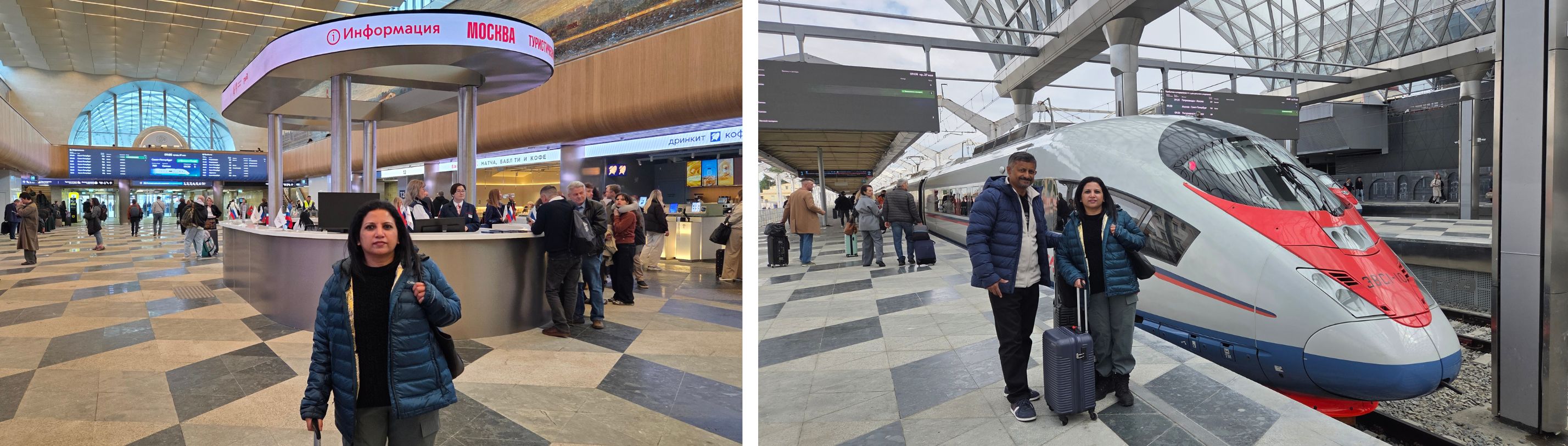
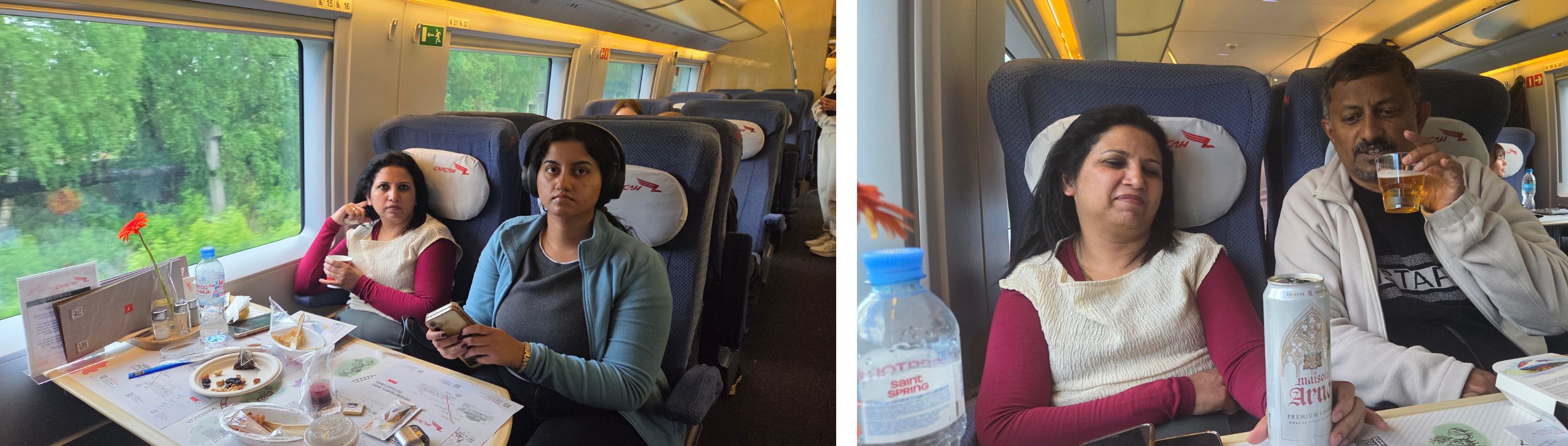
We had booked seats in the **Business (Bistro) Car**, and from the moment we boarded, we knew the experience would be something special. At exactly **9:40 AM**, the Sapsan glided smoothly out of Moscow towards St. Petersburg. The **Sapsan**—named after the peregrine falcon, one of the fastest birds in the world—is Russia's flagship high-speed train. Operating at speeds of up to **250 km/h**, it connects Moscow and St. Petersburg in less than four hours, replacing what was once an overnight rail journey. The ride was incredibly smooth. At times the display showed speeds exceeding **220 km/h**, yet inside the coach there was hardly any sensation of travelling at such high speed. One of the best decisions we had made was booking the Bistro Car. Besides the comfortable seating, Business Class passengers received complimentary food and beverages worth **2,500 Rubles per person**, giving the three of us a combined allowance of **7,500 Rubles**. To make the experience even better, a dedicated attendant looked after our section throughout the journey. He spoke excellent English, provided us with an English menu and patiently explained the available dishes and drinks. Since we had already enjoyed a heavy breakfast at the hotel, our appetites weren't particularly large. Still, we made the most of the journey by ordering a variety of snacks, coffee, soft drinks and, later, I treated myself to a cold beer while watching the Russian countryside pass by outside the window. Even after several rounds of food and drinks, we had only used around **5,000 Rubles** of our allowance. Towards the end of the journey, our attentive host returned with a smile. "You still have about 2,500 Rubles remaining." He genuinely wanted us to make full use of what was included in our ticket. It was a thoughtful gesture and reflected the excellent onboard service we experienced throughout the trip. Right on schedule, at around **1:55 PM**, the Sapsan arrived at **Moskovsky Railway Station** in St. Petersburg.
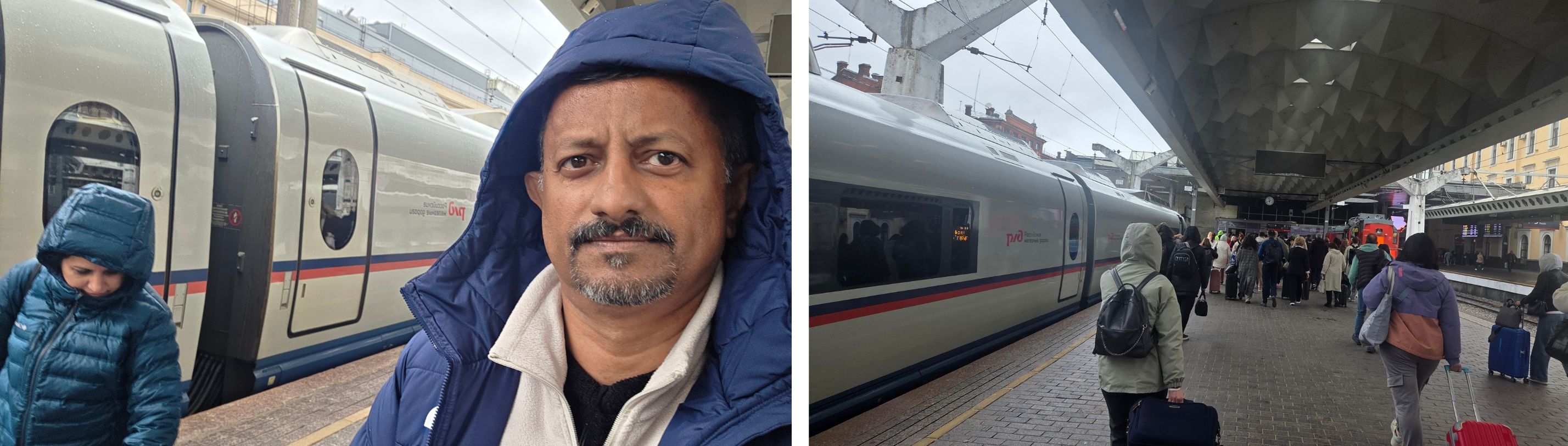
The moment we stepped onto the platform, the difference between the two cities became immediately apparent. Moscow had been pleasant and comfortable. St. Petersburg was noticeably colder. Coming directly from Dubai, the chilly wind hit us almost instantly. Even though it was late May, we quickly realised this city had a completely different climate. The station was considerably busier than expected. Hundreds of passengers were leaving at the same time, creating a brief period of organised chaos as everyone searched for taxis, Metro entrances and hotel transfers. Outside, I opened Yandex and booked our next ride. Due to the sudden rush of arriving passengers, the driver took a little longer than usual to reach the designated pickup point, but before long we were on our way to our hotel. Around **2:30 PM**, we arrived at **Cosmos Selection Saint Petersburg Nevsky Royal Hotel**. We had booked a **City View Room**, but unfortunately the view wasn't quite what we had expected. Looking out of the window, there wasn't much to see. Normally I might have requested a room change. But on this occasion... It was raining. The weather was cold. We were tired after travelling. Sometimes it's better to stop worrying about the small things and simply enjoy the journey. So that's exactly what we did. After checking in, we relaxed in the room until around **6 PM**.
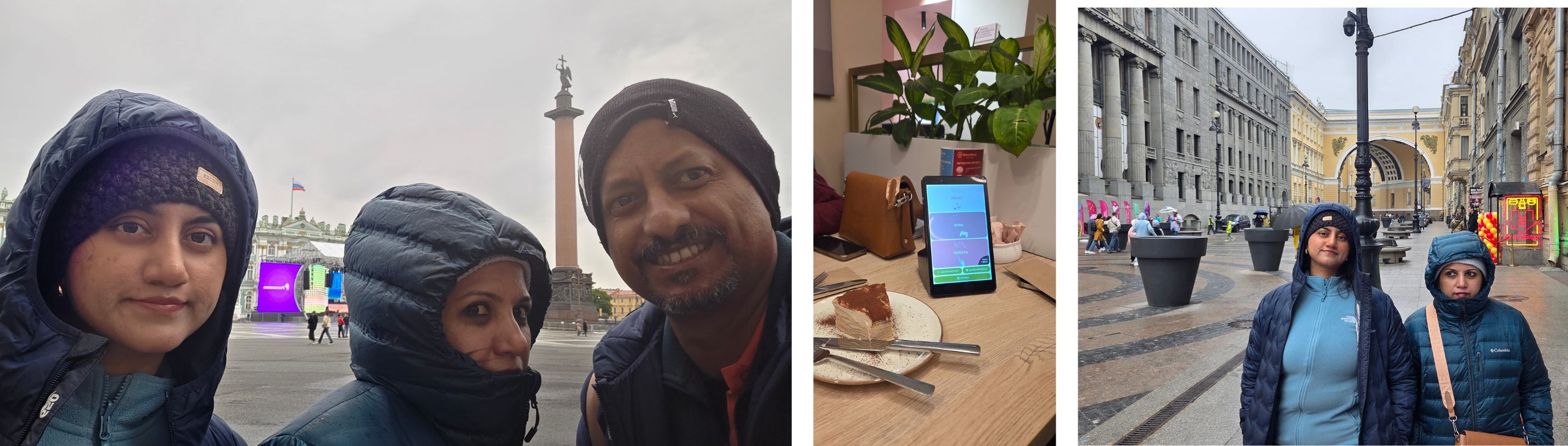
Refreshed and ready for our first glimpse of St. Petersburg, we headed out into the evening. Our first destination was the magnificent **Palace Square**, the historic heart of St. Petersburg. Surrounded by some of Russia's most important buildings—including the Winter Palace and the General Staff Building—Palace Square has witnessed many defining moments in Russian history. Standing in the centre of the enormous square, we immediately understood why St. Petersburg is often called Russia's cultural capital. Unlike Moscow, which feels powerful and monumental, St. Petersburg felt elegant and European. We spent some time wandering around the square before continuing our walk along the famous **Nevsky Prospect**, the city's main avenue. Eventually we stopped at **Sh Nevskiy PR18** for some evening snacks. Ordering food here became another little adventure. The restaurant used tablet-based ordering, entirely in Russian. Fortunately, by now we had become experts at improvisation. One mobile phone displayed the menu. The second phone ran Yandex Translate. Between the two devices—and plenty of trial and error—we successfully placed our order. Technology had once again saved the day. From there we continued walking towards one of St. Petersburg's most famous landmarks.
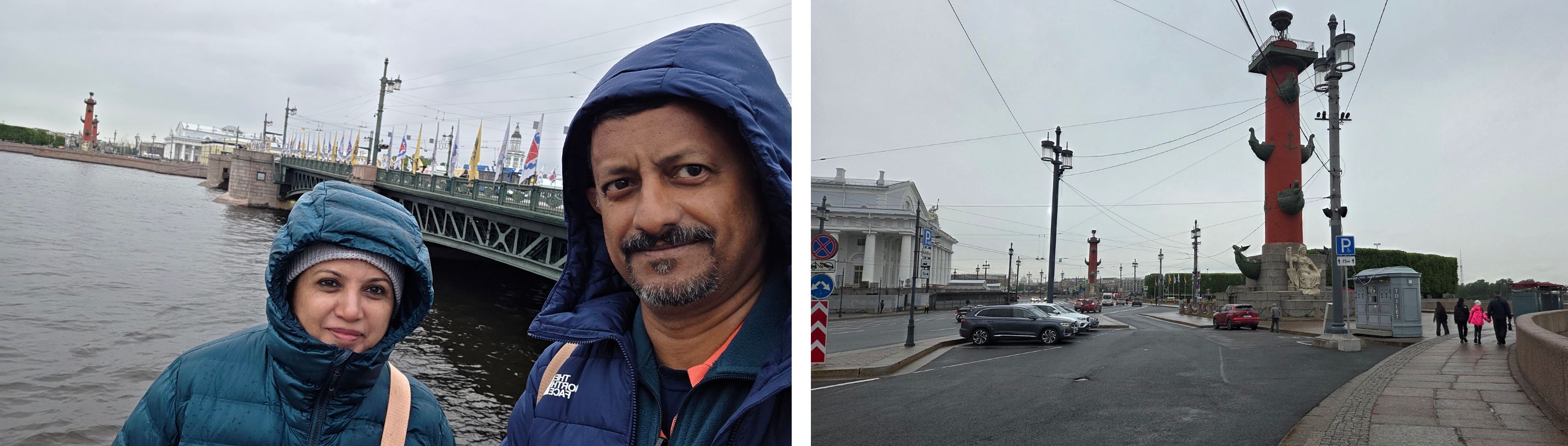
**Palace Bridge.** Crossing the Neva River, Palace Bridge is one of the city's most iconic structures. During summer, it becomes famous for its nightly opening to allow ships to pass along the river. Even during the evening, standing on the bridge offered wonderful views of the river, the historic skyline and the beautifully illuminated buildings lining the embankment. After spending some time enjoying the atmosphere, we decided to return by Yandex rather than continue walking in the cold weather. Back at the hotel, we freshened up before heading out once more. Just a short walk away stood **Galeria Mall**, one of the largest shopping centres in St. Petersburg. Inside, we found a huge food court offering cuisines from around the world. Dinner was easy.
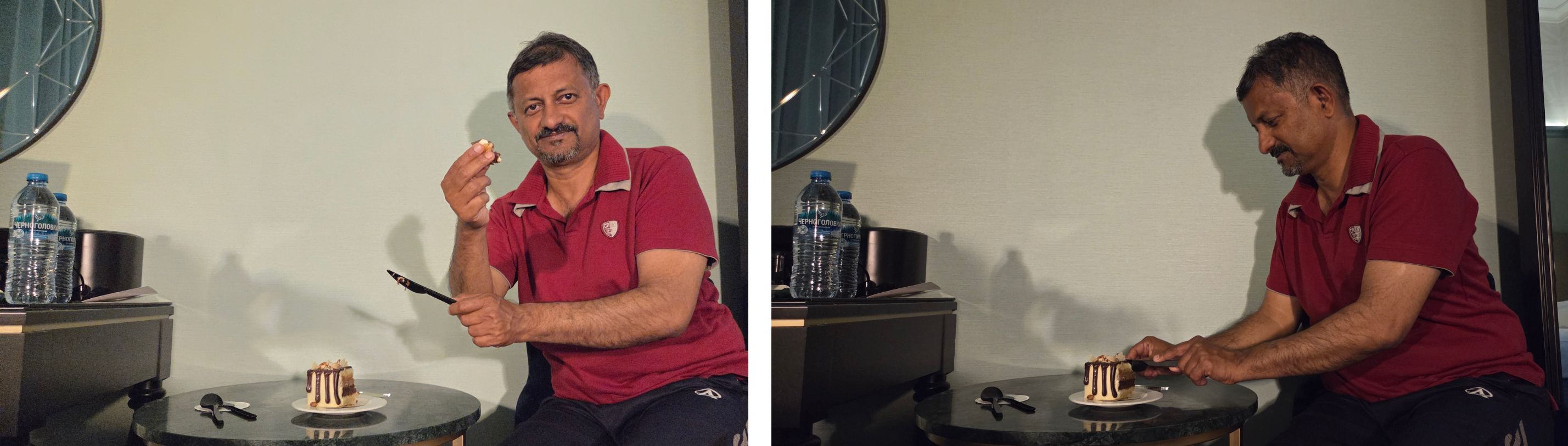
The real surprise, however, came afterwards. Unknown to me, Bijili and Deepali quietly bought a small cake. Since **28th May** was my birthday, they wanted to celebrate the occasion before the day officially began. As we walked back towards the hotel, the rain accompanied us almost the entire way. Several times we stopped under building entrances, waiting for the showers to ease before continuing. By the time we finally reached our room, it was almost midnight. Exactly as the clock struck **12:00 AM**, the lights were switched on. Out came the cake.Together, the three of us celebrated the first few minutes of my birthday in one of the world's most beautiful cities.
A simple cake.
A small family celebration.
Thousands of kilometres away from home.
It was one of those travel moments that money simply cannot buy. **Happy Birthday, Kiran.**With smiles on our faces and another memorable day behind us, we finally called it a night. Tomorrow would be my birthday.
And St. Petersburg was waiting.
Day 6 - May 28, Thursday : Beneath the City & Above History
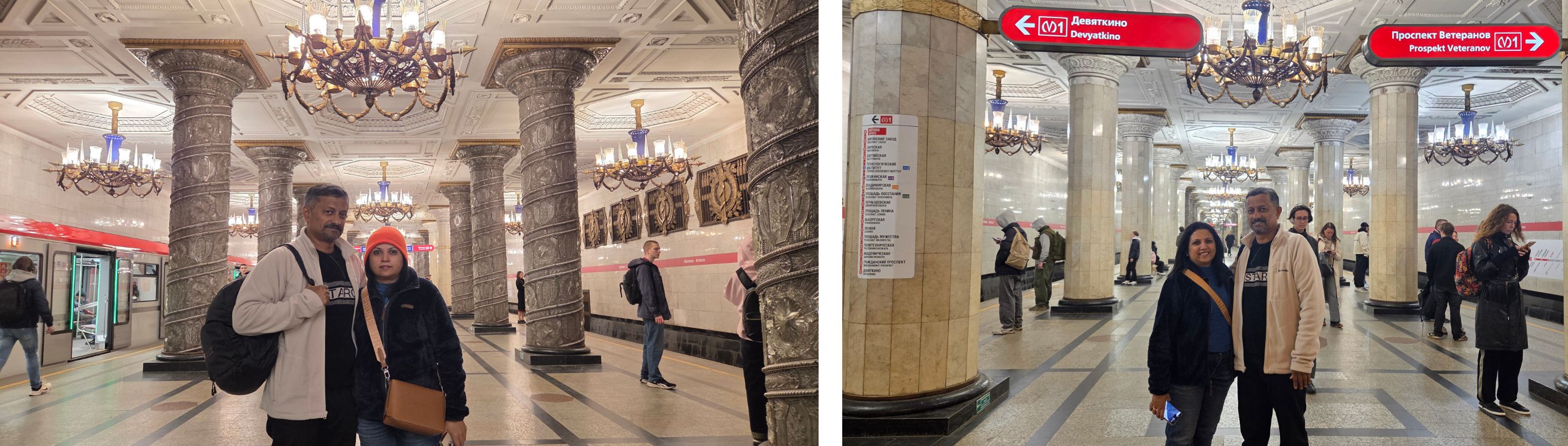
Birthdays are always special. Celebrating one in one of the world's most beautiful cities made it even more memorable. After the little surprise from Bijili and Deepali at midnight, we woke up to my birthday morning in St. Petersburg. A hearty breakfast at the hotel set the tone for another exciting day. Today's theme was simple. Metro stations. Most tourists visit St. Petersburg for its palaces, canals and museums. We were here to admire railway stations. After breakfast, we walked to **Mayakovskaya Metro Station**, purchased three - One day unlimited Metro passes and once again entered one of the world's finest underground railway systems. Our first destination was the legendary **Avtovo Metro Station**. The journey itself took nearly thirty minutes, but every minute was worthwhile. Widely regarded as the most beautiful Metro station in St. Petersburg—and frequently ranked among the finest Metro stations anywhere in the world—Avtovo opened in 1955 as part of the first phase of the city's Metro system. The station is famous for its magnificent marble columns, crystal glass pillars and elegant chandeliers that illuminate the platform with a soft golden glow. Walking into Avtovo felt less like entering a railway station and more like stepping inside a royal ballroom. Photographs simply cannot capture its beauty. The station has to be experienced in person. We spent a long time simply walking around, admiring the architecture and taking photographs before boarding the next train.
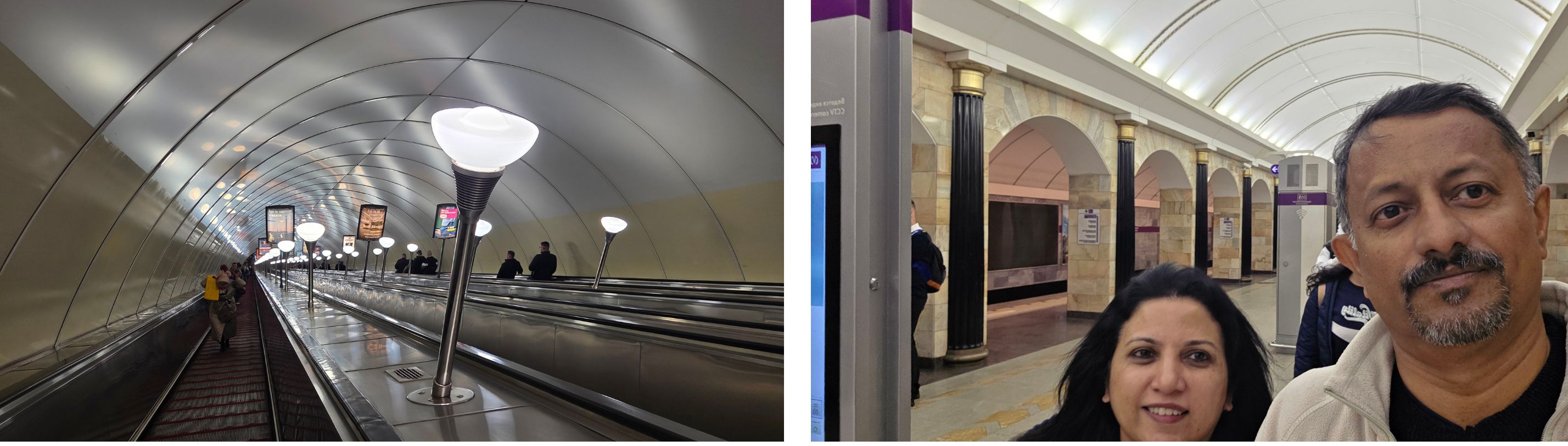
Our next stop promised an entirely different experience. **Admiralteyskaya Metro Station.** While Avtovo impresses with beauty, Admiralteyskaya impresses with engineering. At a depth of around **86 metres**, it is one of the deepest Metro stations in the world. Built beneath the historic centre of St. Petersburg, its impressive depth was necessary because of the city's rivers, canals and challenging soil conditions. The station itself is beautifully decorated with dark marble, elegant lighting and mosaics celebrating Russia's naval heritage. But the real attraction lies above. Or rather...Below.
Before visiting, we had been told that Admiralteyskaya featured one of the world's longest escalators. Naturally, we were excited. When we stepped off the train, however, we found only a short escalator. For a moment we looked at each other in confusion. "Is this it?" Then we turned the corner. There it was. An escalator that seemed to disappear into infinity. All three of us instinctively said the same thing. "Wow..." Standing at the bottom, we couldn't even see where it ended. The ride felt endless. For several minutes we quietly travelled upward through what seemed like an underground tunnel stretching towards the surface. It was unlike anything we had experienced before and remains one of the most memorable moments of our entire Russia trip. Sometimes engineering itself becomes a tourist attraction. Once outside the station, we realised that another famous landmark was only a short walk away.
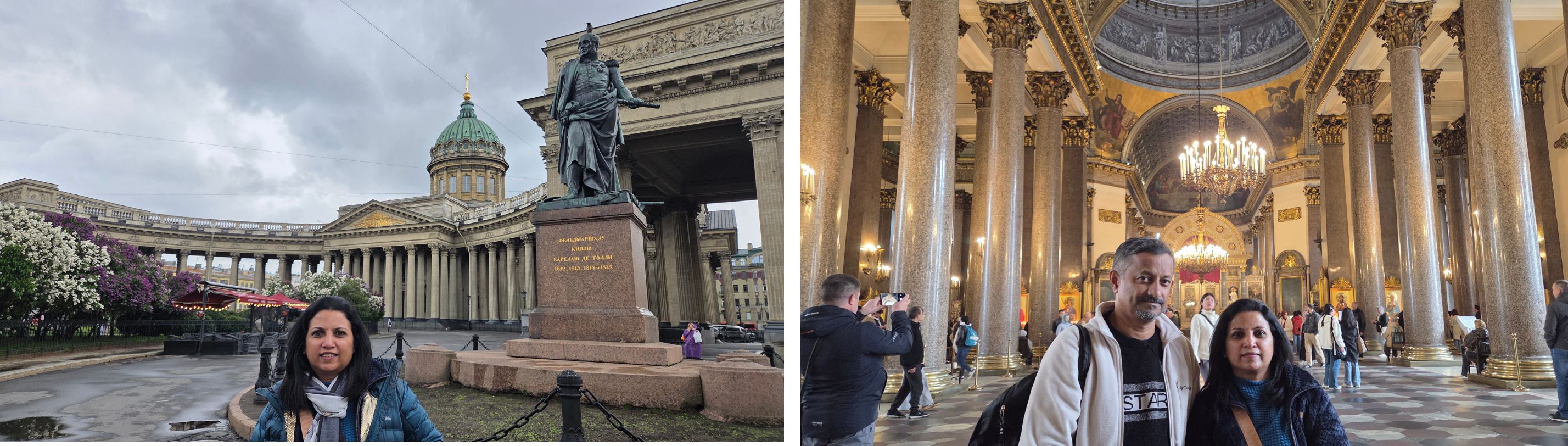
**Kazan Cathedral.** Built in the early nineteenth century, Kazan Cathedral is one of Russia's most important Orthodox churches. Inspired by St. Peter's Basilica in Rome, its magnificent semicircular colonnade embraces the large public square in front, creating one of St. Petersburg's most iconic views. The cathedral also serves as a national memorial, housing the tomb of the celebrated Russian military commander Field Marshal Mikhail Kutuzov, who led Russia during Napoleon's invasion. We spent nearly an hour inside, appreciating its peaceful atmosphere, impressive architecture and beautiful interior. From there we continued on foot to another landmark that had been on our list for months.
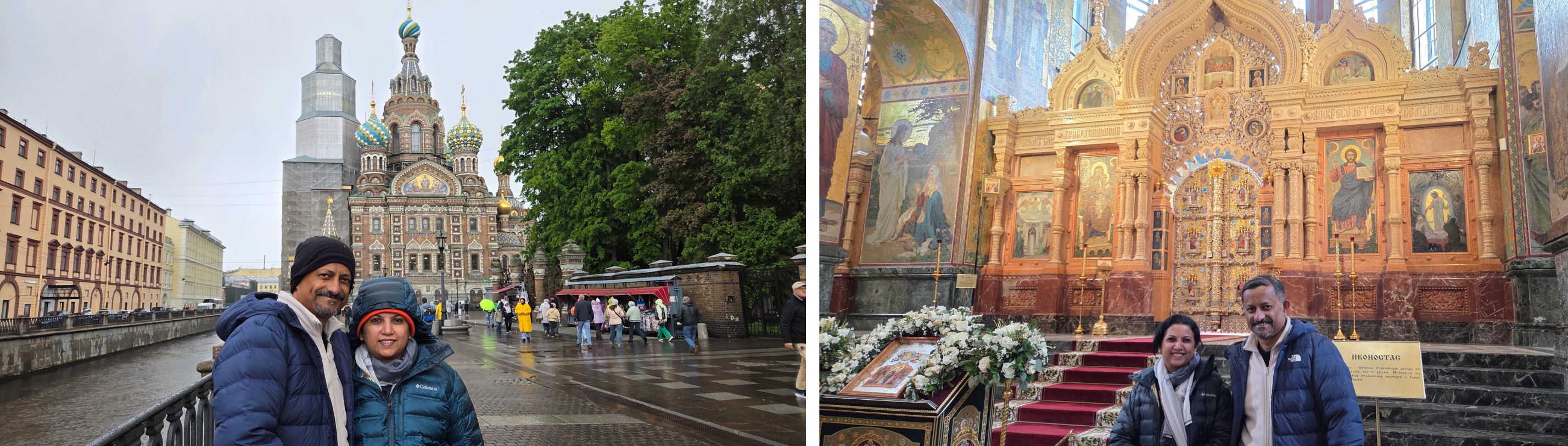
**The Church of the Saviour on Spilled Blood.** Without doubt, this is one of the most spectacular churches in Russia. Built on the exact location where Emperor Alexander II was assassinated in 1881, the church was later constructed as a memorial in his honour. Unlike many buildings in St. Petersburg, its colourful onion domes immediately remind visitors of Moscow's St. Basil's Cathedral. After purchasing our tickets from the self-service machine, we stepped inside.The interior left us speechless. Almost every inch of the walls and ceilings is covered with magnificent mosaics, making it one of the largest collections of mosaic artwork in the world. The colours, craftsmanship and attention to detail were extraordinary.It was another place where we found ourselves looking upward far more than forward. By now, it was time to satisfy another important requirement of any sightseeing day.
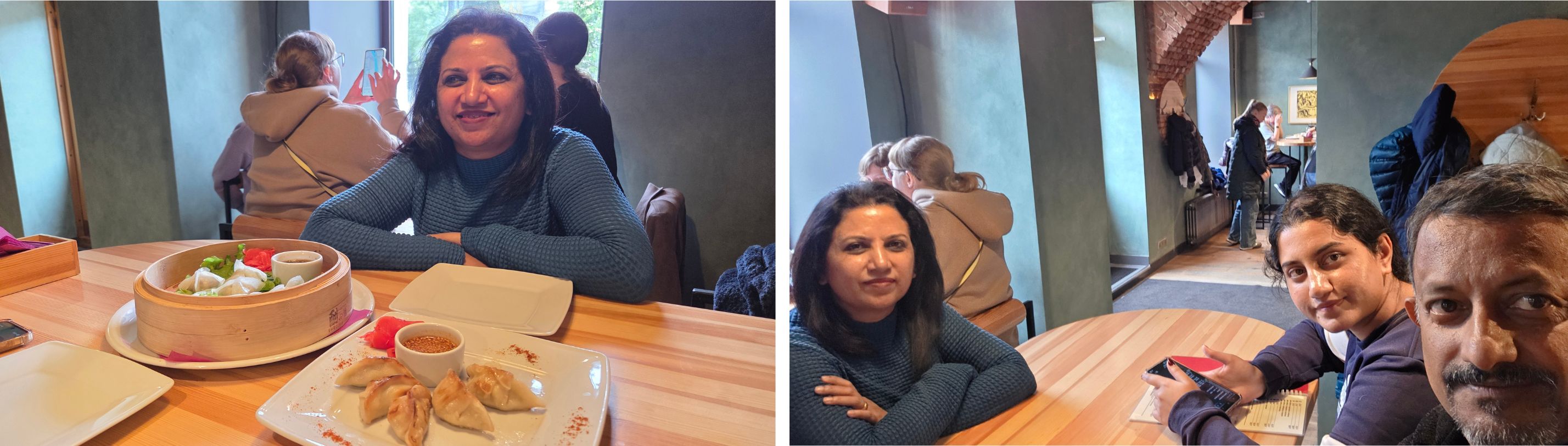
Lunch. Following Deepali's recommendation, we headed to **Pelmenya**, a restaurant famous for its traditional Russian dumplings.The place was packed. We waited nearly thirty minutes before finally getting a table.The wait, however, was completely justified. Pelmenya specialises in **pelmeni**, Russia's famous dumplings, prepared with a variety of fillings including pork, beef, chicken and vegetables. Freshly cooked and served with sour cream and other traditional accompaniments, they turned out to be one of the best meals we enjoyed during our stay in Russia. Sometimes the restaurants with the longest queues really are worth waiting for.
After lunch, we returned to the hotel for a short afternoon break.The weather remained cool, and a little rest prepared us for one final evening in St. Petersburg. As night approached, we wandered through the city without any fixed destination, simply enjoying its atmosphere.
Eventually we arrived at **Ivan Da Marya**, where we had chosen to celebrate my birthday dinner. It proved to be an excellent choice. The restaurant had a warm and elegant ambience, the food was delicious and the service was excellent. It was the perfect setting to celebrate another year of life with the two people who had shared every step of this remarkable journey. Originally, we had planned to remain awake until after midnight to witness one of St. Petersburg's most famous spectacles—the opening of the **Palace Bridge**, when the bridge lifts to allow ships to pass along the Neva River. But nature had different plans. The cold weather, steady rain and several days of continuous sightseeing had finally caught up with us. Reluctantly, we abandoned the idea. Sometimes, travelling also means knowing when to slow down. We returned to the hotel, grateful for another wonderful day. Looking back, I realised that my birthday had been unlike any other. I had celebrated it by travelling through one of the world's deepest Metro stations, standing inside magnificent cathedrals, enjoying authentic Russian cuisine and sharing unforgettable moments with my family in one of Europe's most beautiful cities. I honestly couldn't have asked for a better birthday.
Good Night, St. Petersburg...
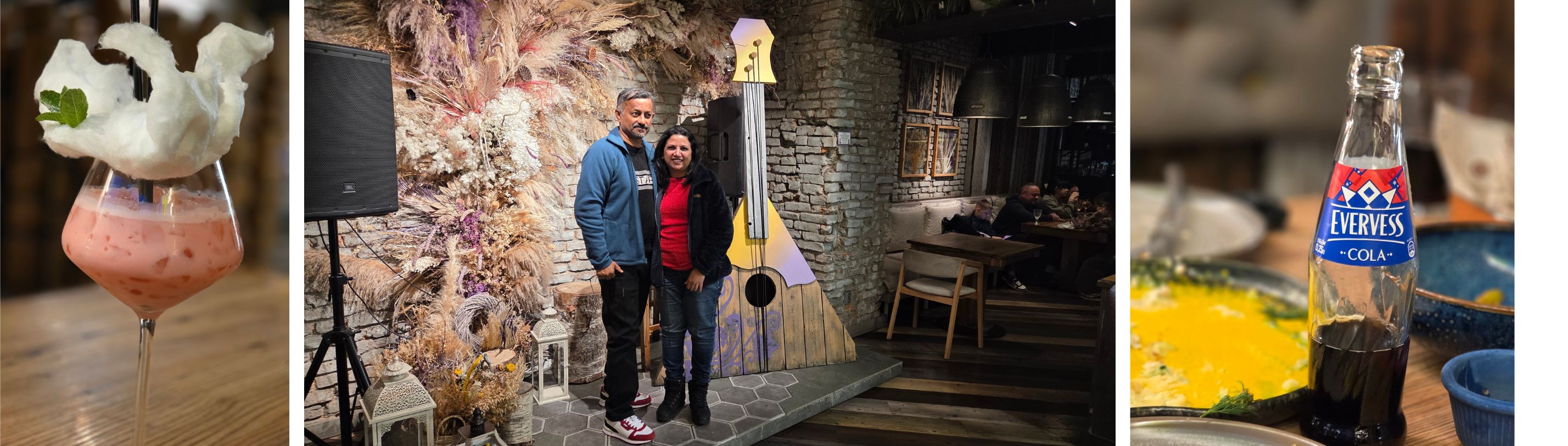
Day 7 - May 29, Friday - Relaxed Farewell to St.Petersburg
Every memorable journey eventually reaches its final day. Our Emirates flight back to Dubai was scheduled to depart late in the evening, giving us one final opportunity to enjoy St. Petersburg at a relaxed pace. The hotel kindly agreed to extend our check-out time until **4:00 PM**, free of charge, allowing us to make the most of our remaining hours without rushing. After another excellent breakfast, we originally planned to visit **Peterhof Palace**, often called the "Russian Versailles." Famous for its magnificent fountains, gardens and grand palaces overlooking the Gulf of Finland, it is considered one of Russia's finest attractions. Unfortunately, the weather had other plans. The cold wind, continuous rain and low temperatures convinced us that comfort would win over sightseeing this time. Sometimes, the best travel decision is knowing when not to force another attraction into the itinerary. Instead, we enjoyed the city at our own pace. The morning was spent browsing souvenir shops, searching for little gifts and keepsakes to bring home for friends, family and colleagues. Every trip deserves a few memories that can be shared with those waiting back home.
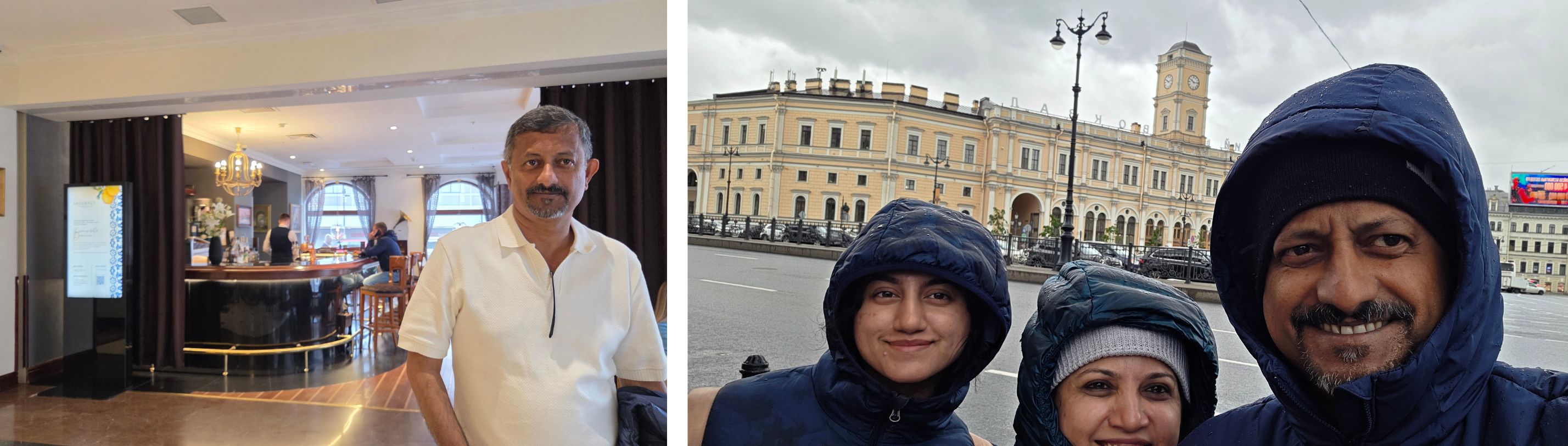
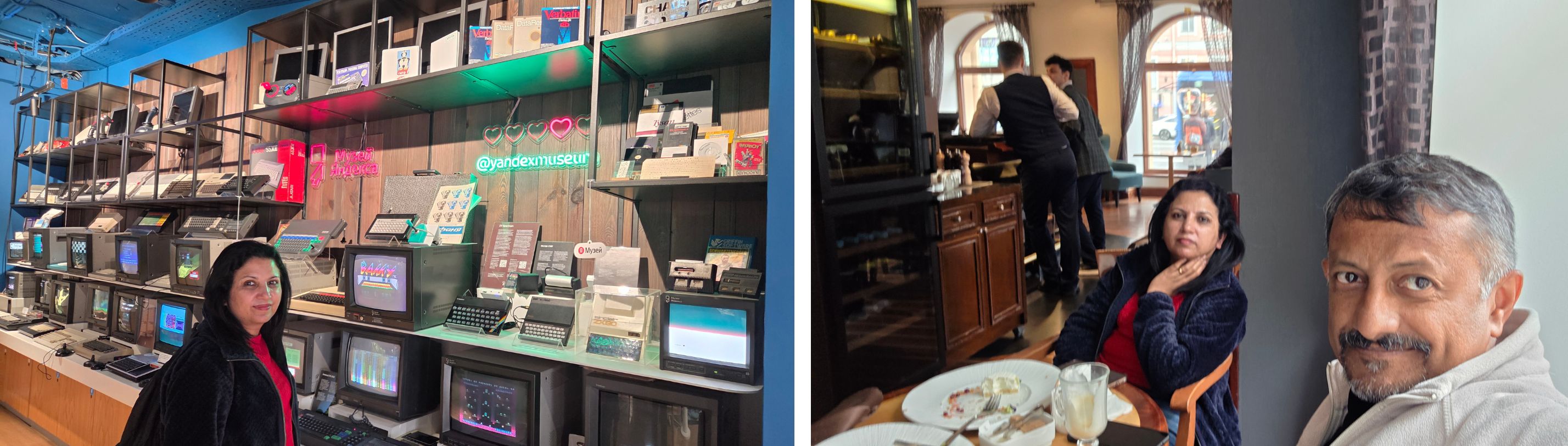
Later we walked once again to **Galeria Mall**, where we spent some time shopping before returning to the familiar **Eat Market** for lunch. By now, navigating food courts, making payments and using Russian apps had become second nature. What had seemed complicated just a few days earlier now felt surprisingly easy. After lunch, we returned to the hotel, completed our final packing and officially checked out at 4 PM, leaving our luggage safely with reception. One final attraction remained. The **Yandex Museum**. For anyone interested in technology, this small museum is a hidden gem. The museum showcases the evolution of personal computers, gaming consoles and electronic devices from the 1980s and 1990s. Walking through the exhibits felt like stepping back into the early days of computing, with many classic machines still functioning and available for visitors to explore. As an engineer, I thoroughly enjoyed the experience. The visit also made me appreciate Yandex even more. Before travelling to Russia, I had assumed Yandex was simply another navigation app. After spending a week in the country, I realised it was much more than that. Yandex has built an entire digital ecosystem that serves as Russia's answer to many Western platforms. During our stay we depended on Yandex for maps, taxis, translations, Metro navigation and much more. It had become an indispensable companion throughout our journey. It was fascinating to see how a country had successfully developed its own technology ecosystem to meet everyday needs. After returning to the hotel, we enjoyed one final coffee and some light refreshments before requesting our last Yandex taxi.
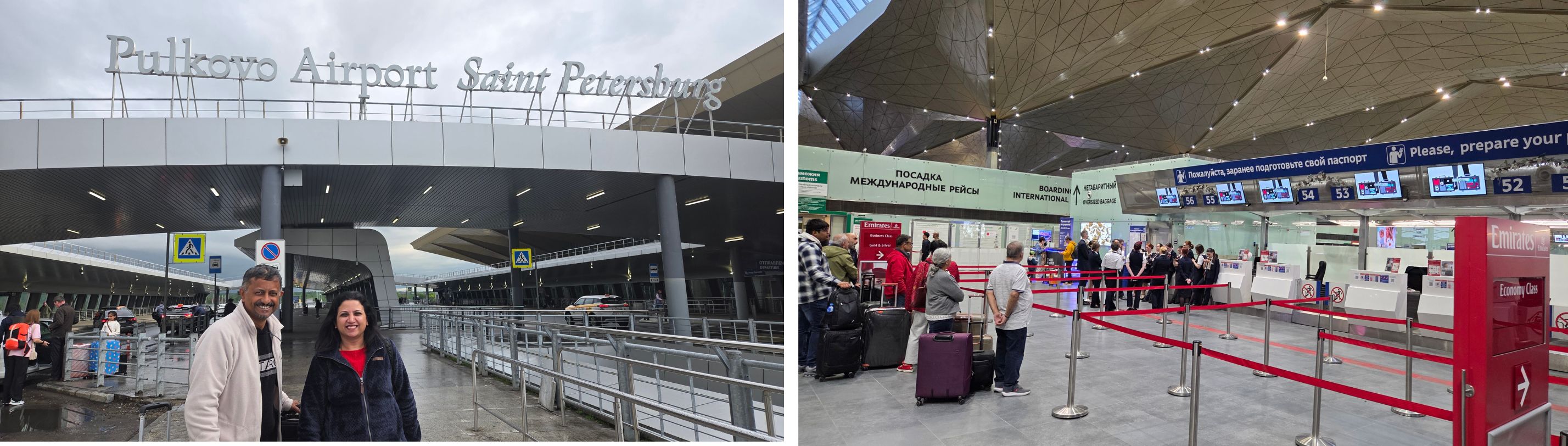
Our destination... **Pulkovo Airport.** The journey itself became one final sightseeing experience. Travelling along the expressway, we enjoyed one last look at St. Petersburg before saying goodbye. Although the fare was slightly higher than our usual city rides, the smooth highways and comfortable drive made it worthwhile. At the airport, check-in was quick and efficient. Immigration, however, proved more thorough than our arrival in Moscow. Officers carefully examined every page of our passports and even used ultraviolet lights to inspect the documents before finally stamping us out of the country. One final reminder that we were leaving Russia. After immigration we discovered another consequence of international sanctions. Our Mastercard Lounge access was not accepted at the airport. Instead, we found a nearby café, enjoyed a light snack and waited for boarding. Around **10:15 PM**, we boarded our Emirates flight. It was time to say goodbye. До свидания, Россия.
Day 8 - May 30, Saturday - Homeward Bound
The journey home gave us one last reminder of the changing world. Before the regional conflicts, the flight between St. Petersburg and Dubai usually took around six hours. Now it required almost eight. Just as on our inbound journey, the aircraft had to avoid the airspace over Ukraine and Iran. Instead, our route curved west before heading south via Turkey, Jordan, Saudi Arabia and Oman before finally entering UAE airspace. The additional flying time hardly mattered. Our minds were still occupied with the incredible week we had just experienced. Emirates once again provided excellent service, with good food, refreshments and a comfortable journey throughout the night. As dawn approached, the familiar coastline of Dubai appeared beneath the aircraft. At approximately **7:30 AM**, we landed safely. Back home. Immigration and baggage collection were completed smoothly, and by around **9:00 AM** we reached our home. The moment we stepped outside Dubai International Airport, we immediately felt something we had almost forgotten during the past week. The heat. Only then did we realise how quickly we had become accustomed to Russia's cool weather. Our Russian adventure had come to an end.But the memories would stay with us forever.
🌍 Closing Thoughts
When I first suggested Russia as our holiday destination, none of us imagined how extraordinary this journey would become. The adventure actually began long before we boarded the Emirates flight from Dubai. Obtaining an e-Visa was straightforward, but almost everything else required careful planning. We had to purchase a special Russian travel insurance policy, open Russian financial accounts, fund YooMoney through cryptocurrency, arrange a T-Bank account, understand the MIR payment system, download several Russian applications, and even book hotels and train tickets through Russian websites because many international platforms no longer operate there. Every step reminded us that this would not be an ordinary holiday.Yet once we landed in Moscow, those concerns slowly disappeared. Our phones became our travel companions. Yandex guided us through unfamiliar streets, translated conversations, booked taxis, planned Metro routes and helped us navigate one of the world's most efficient transport systems. T-Bank and YooMoney became our wallets. The Moscow and St. Petersburg Metro became our classrooms. By the end of the week, everything that had seemed complicated before departure had become second nature. Sometimes, the most memorable journeys are the ones that begin with the greatest uncertainty.
🌍 Conclusion
Russia turned out to be very different from the image often portrayed in international news. We discovered magnificent Metro stations that resemble underground palaces rather than railway stations. We walked through centuries of history in Red Square, the Kremlin and St. Basil's Cathedral. We stood before Lenin's Mausoleum, explored the remarkable achievements of the Soviet and Russian space programmes, visited the iconic Luzhniki Stadium, travelled aboard the high-speed Sapsan train, admired the beauty of St. Petersburg's canals and cathedrals, and experienced the warmth of ordinary Russians despite the language barrier. What impressed us most was that the language barrier never became a real obstacle. Whenever we looked confused, someone was always willing to help sometimes with a few English words, often with simple gestures, and occasionally through a translation app. Kindness needs no common language. Moscow and St. Petersburg each left a different impression. Moscow impressed us with its power, engineering, history and scale. St. Petersburg captivated us with its elegance, canals, architecture and relaxed European atmosphere. Although international sanctions have changed many aspects of travelling to Russia, we found that with proper planning, patience and the right preparation, travelling independently was not only possible but also extremely rewarding. Looking back today, all three of us agree on one thing. Choosing Russia was one of the best travel decisions we have ever made.
🌍 Trip Highlights & Lessons Learned ✈️
- Successfully travelling independently through Russia despite international sanctions.
- Using Russian digital services such as Yandex, T-Bank, YooMoney and MIR Pay throughout the trip.
- Exploring the spectacular Moscow Metro and the equally impressive stations of St. Petersburg.
- Visiting Red Square, the Kremlin and Lenin's Mausoleum.
- Touring the iconic Luzhniki Stadium, venue of the 2018 FIFA World Cup Final.
- Travelling at over 220 km/h aboard the Sapsan high-speed train.
- Discovering the remarkable achievements of the Soviet and Russian space programme at the Cosmonautics Museum.
- Celebrating my birthday in St. Petersburg with my family.
- Experiencing two completely different cities within one country, each with its own unique identity.
- Completing an unforgettable journey safely during a period many people considered challenging for travel.
- Never judge a country solely through headlines or television debates.
- Thorough planning makes even the most complicated destinations surprisingly easy to explore.
- Technology can completely transform the travel experience. Without Yandex and the Russian banking ecosystem, this journey would have been far more difficult.
- Learning a few local words and respecting local customs always creates goodwill.
- Public transport often provides a richer travel experience than simply taking taxis everywhere.
- Sometimes the best memories come from unexpected moments—a stranger helping at the Metro gate, sharing smiles despite the language barrier, or simply wandering through unfamiliar streets.
Finally, if someone asked me today whether Russia is worth visiting, my answer would be simple: Absolutely. Go with an open mind. Prepare well. Download the right apps. Respect the local culture. And experience the country for yourself. Because the real Russia is not found on television—it is found in its Metro stations, its historic streets, its engineering marvels, its architecture, its cafés, and above all, its people. As I look back on this journey, one sentence perfectly sums up the entire experience:
"I expected to visit Russia. Instead, I discovered a completely different world." Спасибо, Россия. Until we meet again. 🇷🇺
Posted by Kiran Arjun - 25-06-2026
This blog's narrative and structure wouldn't have been possible without the assistance of ChatGPT, which brilliantly transformed my thoughts into words. Kudos to technology for making stortelling more accessible !